The progress of scientific chemistry in our own times : with biographical notices / by William A. Tilden.
- William A. Tilden
- Date:
- 1913
Licence: Public Domain Mark
Credit: The progress of scientific chemistry in our own times : with biographical notices / by William A. Tilden. Source: Wellcome Collection.
127/390 page 111
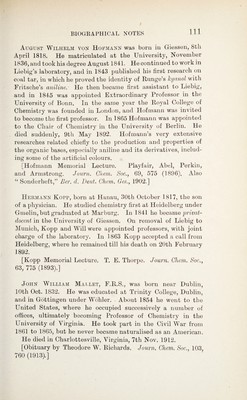
![August Wilhelm von Hofmann was born in Giessen, 8th April 1818. He matriculated at the University, November 1836, and took his degree August 1841. He continued to work in Liebig’s laboratory, and in 1843 published his first research on coal tar, in which he proved the identity of Runge’s kyanol with Fritsche’s aniline.' He then became first assistant to Liebig, and in 1845 was appointed Extraordinary Professor in the University of Bonn. In the same year the Royal College of Chemistry was founded in London, and Hofmann was invited to become the first professor. In 1865 Hofmann was appointed to the Chair of Chemistry in the University of Berlin. He died suddenly, 9th May 1892. Hofmann’s very extensive researches related chiefly to the production and properties of the organic bases, especially aniline and its derivatives, includ¬ ing some of the artificial colours. [Hofmann Memorial Lecture. Playfair, Abel, Perkin, and Armstrong. Journ. Chem. Soc., 69, 575 (1896). Also “ Sonderheft,” Ber. d. Deut. Chem. Ges., 1902.] Hermann Kopp, born at Hanau, 30th October 1817, the son of a physician. He studied chemistry first at Heidelberg under Gmelin, but graduated at Marburg. In 1841 he became privat- docent in the University of Giessen. On removal of Liebig to Munich, Kopp and Will were appointed professors, with joint charge of the laboratory. In 1863 Kopp accepted a call from Heidelberg, where he remained till his death on 20th February 1892. [Kopp Memorial Lecture. T. E. Thorpe. Journ. Chem. Soc., 63, 775 (1893).] John William Mallet, F.R.S., was born near Dublin, 10th Oct. 1832. He was educated at Trinity College, Dublin, and in Gottingen under Wohler. About 1854 he went to the United States, where he occupied successively a number of offices, ultimately becoming Professor of Chemistry in the University of Virginia. He took part in the Civil War from 1861 to 1865, but he never became naturalised as an American. He died in Charlottesville, Virginia, 7th Nov. 1912. [Obituary by Theodore W. Richards. Journ, Chem. Soc., 103, 760 (1913).]](https://iiif.wellcomecollection.org/image/b31358858_0127.jp2/full/800%2C/0/default.jpg)
 No text description is available for this image
 No text description is available for this image
 No text description is available for this image