On rest and pain : a course of lectures on the influence of mechanical and physiological rest in the treatment of accidents and surgical diseases, and the diagnostic value of pain delivered at the Royal College of Surgeons of England in the years 1860, 1861, and 1862 / by John Hilton ; edited by W.H.A. Jacobson.
- Date:
- 1877
Licence: Public Domain Mark
Credit: On rest and pain : a course of lectures on the influence of mechanical and physiological rest in the treatment of accidents and surgical diseases, and the diagnostic value of pain delivered at the Royal College of Surgeons of England in the years 1860, 1861, and 1862 / by John Hilton ; edited by W.H.A. Jacobson. Source: Wellcome Collection.
Provider: This material has been provided by the Royal College of Physicians of Edinburgh. The original may be consulted at the Royal College of Physicians of Edinburgh.
46/504 page 26
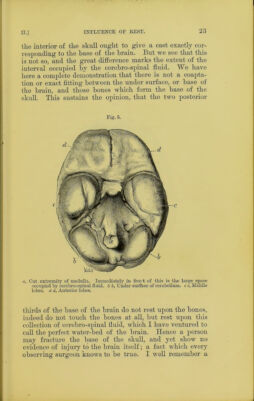
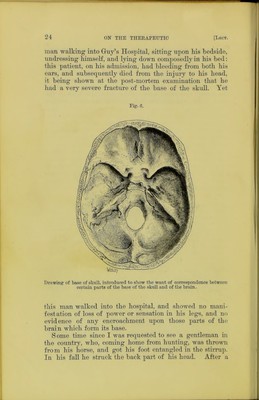
![ON THE THERAPEUTIC [Lect. effect was propagated to its anterior part—that part which, fits accurately upon the bones of the skull—here the under and anterior part of the brain was very much lace- rated. These circumstances taken together will show, I think, the practical advantage of distinguishing the parts of the brain which fit accurately upon the skull from those parts which are separated from it by the interposition of the cerebro-spinal fluid. The cerebro-spinal fluid has a specific gravity of about 1007. It contains scarcely any albumen, and is, therefore, very different from the serum of the blood. The function of this cerebro-spinal fluid is chiefly mechanical—that is, first, to protect the more important parts of the brain from vibratory communications from the bones of the skull which might otherwise reach them ; * the brain, therefore, at its base does not rest upon the bones, but upon the fluid; secondly, this fluid isolates the various nerves passing near each other towards the same foramina; and, lastly, sup- ported by the cerebral circulation, it tends to bring back the internal organs of the brain to a state of comparative emptiness or quiescence after their state of activity. In this latter respect the cerebro-spinal fluid may be said to perform for the parts in the interior of the brain a function analogous to that capsular apparatus to which I have already referred as investing some of the thoracic and abdominal viscera. I will now elucidate the office of this cerebro-spinal fluid as a mechanical support to the internal parts of the brain, when they have ceased to be in the condition of phjrsio- log-ical excitement or turgescence. I have already said that the thalamus nervi optici and the corpus striatum, which occupy the base of the lateral ventricles, superintend the movements and sensibility of the upper and lower extremities. I presume that when these functions are actively employed, these two parts especially are in a state of turgescence, and that if they were imbedded in the solid brain it would be impossible for them to enlarge without * Mr. Hilton has shown elsewhere (Lectures on the Cranium) that many of the ridges on the inner surface of the base of the skull serve to conduct vibrations to the clinoid processes which lie surrounded by cerebro-spinal fluid, and that the vibrations arrested and lost in this fluid are thus prevented from damaging the base of the brain.—[Ed.]](https://iiif.wellcomecollection.org/image/b21952231_0046.jp2/full/800%2C/0/default.jpg)
 No text description is available for this image
 No text description is available for this image
 No text description is available for this image