Epidemiology of mongolism / Abraham M. Lilienfeld, with the assistance of Charlotte H. Benesch.
- Abraham Lilienfeld
- Date:
- [1969]
Licence: Attribution-NonCommercial-NoDerivatives 4.0 International (CC BY-NC-ND 4.0)
Credit: Epidemiology of mongolism / Abraham M. Lilienfeld, with the assistance of Charlotte H. Benesch. Source: Wellcome Collection.
115/168 page 97
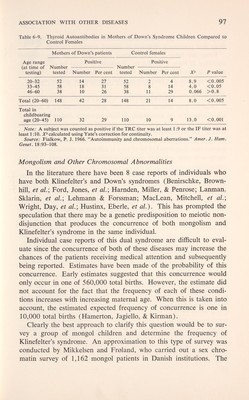
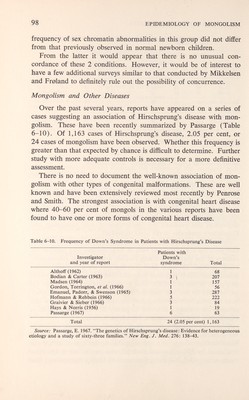
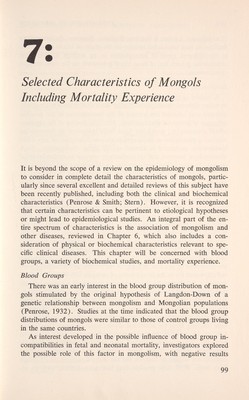
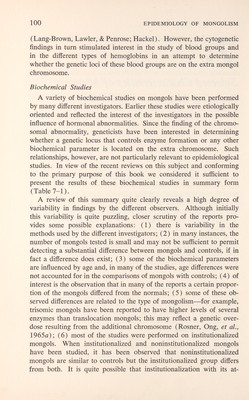
![ASSOCIATION WITH OTHER DISEASES 97 Table 6-9. Thyroid Autoantibodies in Mothers of Down's Syndrome Children Compared to Control Females Note: A subject was counted as positive if the TRC titer was at least 1 ;9 or the IF titer was at least 1:10. calculated using Yate's correction for continuity. Source: Fialkow, P. J. 1966. Autoimmunity and chromosomal aberrations. Amer. J. Hum. Genet. 18:93-108. Mongolism and Other Chromosomal Abnormalities In the literature there have been 8 case reports of individuals who have both Klinefelter's and Down's syndromes (Benirschke, Brown- hill, et al; Ford, Jones, et al.', Harnden, Miller, & Penrose; Lanman. Sklarin, et al.] Lehmann & Forssman; MacLean, Mitchell, et al.; Wright, Day, et al. ; Hustinx, Eberle, et al. ). This has prompted the speculation that there may be a genetic predisposition to meiotic non¬ disjunction that produces the concurrence of both mongolism and Klinefelter's syndrome in the same individual. Individual case reports of this dual syndrome are difficult to eval¬ uate since the concurrence of both of these diseases may increase the chances of the patients receiving medical attention and subsequently being reported. Estimates have been made of the probability of this concurrence. Early estimates suggested that this concurrence would only occur in one of 560,000 total births. However, the estimate did not account for the fact that the frequency of each of these condi¬ tions increases with increasing maternal age. When this is taken into account, the estimated expected frequency of concurrence is one in 10,000 total births (Hamerton, Jagiello, & Kirman). Clearly the best approach to clarify this question would be to sur¬ vey a group of mongol children and determine the frequency of Klinefelter's syndrome. An approximation to this type of survey was conducted by Mikkelsen and Froland, who carried out a sex chro¬ matin survey of 1,162 mongol patients in Danish institutions. The](https://iiif.wellcomecollection.org/image/b18025961_0116.JP2/full/800%2C/0/default.jpg)
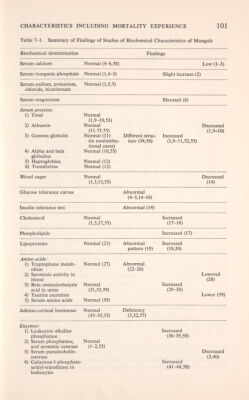
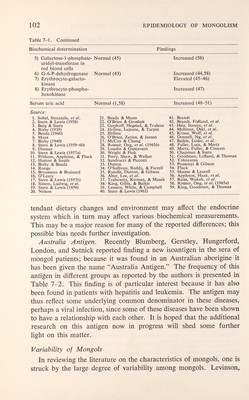
 No text description is available for this image
 No text description is available for this image
 No text description is available for this image