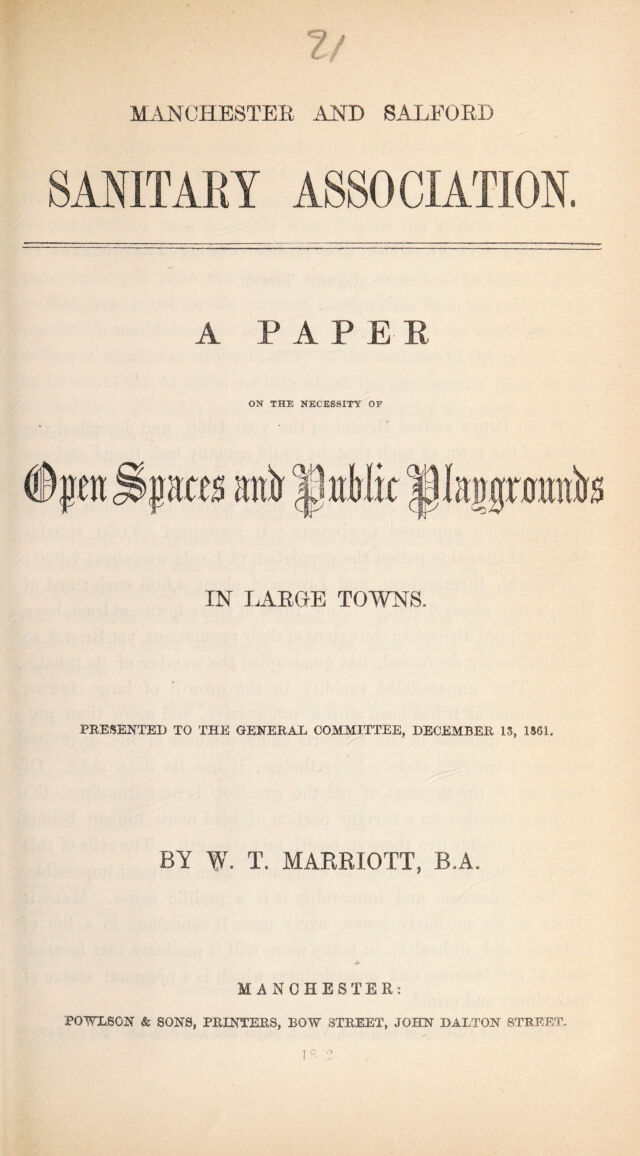
A paper on the necessity of open spaces and public playgrounds in large towns / presented to the General Committee, December 13, 1861 by W. T. Marriott.
- Manchester and Salford Sanitary Association.
- Date:
- 1862
Licence: Attribution 4.0 International (CC BY 4.0)
Credit: A paper on the necessity of open spaces and public playgrounds in large towns / presented to the General Committee, December 13, 1861 by W. T. Marriott. Source: Wellcome Collection.
11/12 page 11
![vices peculiar to their class, but if, notwithstanding all that has hitherto been done for them, those vices are almost the necessary consequence of their condition, to bring them up as accusations is most unreasonable. Those who do so should remember a remark made by Wash¬ ington to some members of Congress who had been indulging in the agreeable pastime of grumbling. In reply to their complaints of the short-comings of his soldiers, he assured them that “ it was a much “easier andless distressing thing to draw up remonstrances inacomfort- “ able room by a good fireside, than to occupy a cold bleak hill, and sleep “under frost and snow, without clothes or blankets.” So with regard to the rich man and the operative, there are two points of view from which the state of the latter may be contemplated—and the view from one point is very different to that from the other. To the gentleman who at the conclusion of the day’s business sits at his mansion at Eccles or Didsbury, surrounded with every luxury and comfort that money can procure, cracking his walnuts and sipping his claret in a social circle of friends, the view is very different to what it is to the occupant of Cupid’s Alley or Lad Lane, who, having spent a quarter of an hour in “ bolting ” his tea, has before him three or four hours of utter vacancy. The one can philosophize on what has been done. The other feels what is left undone. The former, far removed from the scene he contemplates, passes in review the pro¬ gressive state of the working classes, and dilates on the numerous comforts they now enjoy. With streets well paved, well drained, well lighted, well supplied with water, with schools close to their doors, with the best medical aid at hand, with libraries which univer¬ sities might envy, and parks which noblemen might covet, surely the meanest artisan of the 19th century, say they, is better off than a prince in the times of the Saxons. I The other, probably, does not think, or reflect, or generalize, or I compare his state to what it would have been had he lived 10, or 20, ] or 100 years ago. He feels—he feels it as it is, and it is this feeling which shapes and colors his course of life. He takes his circum¬ stances as they are, and acts accordingly. So long as those circum-](https://iiif.wellcomecollection.org/image/b30106655_0011.jp2/full/800%2C/0/default.jpg)