Report of the Royal Commission on the Poor Laws and Relief of Distress.
- Royal Commission on the Poor Laws and Relief of Distress 1905-09
- Date:
- 1909
Licence: Public Domain Mark
Credit: Report of the Royal Commission on the Poor Laws and Relief of Distress. Source: Wellcome Collection.
233/1272 page 207
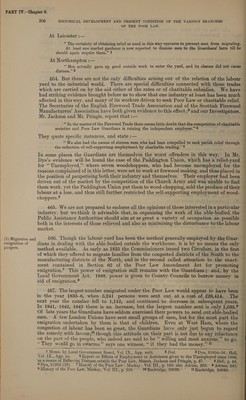
![THE ABLE-BODIED UNDER THE POOR LAW. 207 468. In the Report of the Local Government Board for 1906-7 a table is given from which we learn that the number of adults emigrated under the Poor Law, though still very small, is gradually increasing. The numbers emigrated to Canada for the ten years ended 1906 have been: 7, 7, 16, 15, 16, 26, 51, 70, 300, 479. The numbers emigrated to other countries are negligible.1 It is a form of assistance which can be properly afforded only to men of good character and good physique; if those qualities are wanting the emigrant is not likely to succeed even if he pass the health test generally required in the new country. 469, Migration was more favoured than emigration by the Poor Law Commissioners ot 1834, owing to its lesser cost; and the early years of their rule saw a large migration from the Southern Counties to the northern. Owing to a change in the law under the General Consolidated Order it seems doubtful whether Guardians now have the power to migrate applicants for relief for the sake of improving their position, although they may ‘“‘remove ”’ them for the sake of saving the rates even to the applicants’ own detriment. That excellent work can be done by assisting families to remove from places where there is no demand for their work is shown in the evidence given by Mr. Grisewood; ? and of late in some districts the Guardians have apparently taken the matter into their own hands. 470. The unsatisfactory features of work in a labour-yard have always been seen, (3) Work for and have led enterprising Boards to attempt something more healthy and more remunera- wages. ative. The earliest experiment of which we have record is one made in 1839 by the Chorlton Board. The information given in the Ninth Annual Report? of the Poor Law Commissioners is not very clear, but it seems to amount to this: that, in 1839, the Chorlton Board of Guardians, perceiving the increasing badness of the times, and anticipating that spinners and others would be thrown out of employment in large num- bers, made an agreement with the proprietor of Chat Moss to let them put labourers to work in reclaiming some 94 acres of the Moss. ‘The principle on which this was based was not that of providing work at wages for the unemployed, nor yet economy in relief expenditure, but to afford an effective labour test to applicants: “ It is the fact that we have work to offer—regular organised, and constant work—that deters the idle and worthless from applying for relief.”’ On this some sixty men were set to work, at a payment of Is. 6d. per day, the Guardians giving as many days’ work as the necessities of the man and his family required, and leaving the men to take any other employment they could get on the other days. The result, as regards the Moss, was that, in two years time, bog which had not been worth 1s. an acre was covered with wheat, potatoes, and turnips not to be surpassed in the best managed farms in the best cultivated County in England, and was estimated as worth £50 an acre. As regards the paupers, the calculation was that, for £176 8s., being “the whole balance of outlay for which there is no apparent return,” 385 able-bodied persons had been maintained for a period of a year and three- quarters, “‘ who must otherwise have been relieved at an enormously increased cost without requiring labour in return, to say nothing of 135 positive refusals to work, and the hundreds of idle persons who had been deterred from applyimg by the knowledge that work would be offered.”’ 471. This successful experiment is of special interest when compared with a similar experiment made by the Manchester Distress Committee in 1906. In Mr. Jackson’s Report, he writes : “We understand that the large works which were carried out last year at Chat Moss by the Manchester unemployed will be entirely useless, as the land is to be allowed to revert again to its original state, which the peaty soil does very quickly. In the Manchester Distress Committee’s Report the amount spent on this experiment is not very clear. Sheds for the men were erected at a cost of £171 8s. 4d., and as 252 men in all worked there in two batches of 100 for periods up to sixteen weeks each, the wages must have been very considerable, possibly over £2,000. At Oldham some few acres of moor were cultivated, and will probably have to be abandoned. The result obtained for an expenditure of some hundreds of pounds will be the growth of £20 worth of potatoes.” 4 1 Thirty-sixth Annual Report, Local Government Board (Cd. 3665], 1907, p. 402. 2 Grisewood, 37211- 27; 37269-79. Vide also Abbott, 87178-90. 3 Ninth Annual Report, Poor Law Commissioners, 468, 1843, App .A., p. 49. | 4 Report on the Effects of Employment or Assistance given to the Unemployed since 1886 us a means of Relieving Distress outside the Poor Law : Messrs. Jackson and Pringle, p. 124. 429 , Dean,](https://iiif.wellcomecollection.org/image/b32170555_0233.jp2/full/800%2C/0/default.jpg)