[Report of the Medical Officer of Health for Kensington Borough].
- Kensington (London, England). Royal Borough.
- Date:
- [1912]
Licence: Attribution-NonCommercial 4.0 International (CC BY-NC 4.0)
Credit: [Report of the Medical Officer of Health for Kensington Borough]. Source: Wellcome Collection.
19/106 page 11
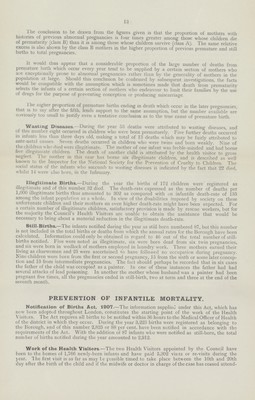
![11 and suggests that the infant's chance of surviving is substantially less if the mother is a laundry woman. On the other hand the figures do not justify the conclusion that laundry work exercises an adverse effect on the child during pregnancy, since the majority of the women employed in laundries during pregnancy return to the same work after their confinement, with the result that their babies have to be minded during the day by neighbours, whose methods of bottle feeding generally leave much to be desired. Mention may also be made of the fact that in deaths from prematurity and in still-births, which are necessarily due to ante-natal conditions, the occupation of the mother during pregnancy appears to exercise no influence. Thus in the Table of occupations during pregnancy the proportion of mothers engaged in laundry work is given under the three headings Survivors, Deaths from Prematurity, and Still Births, as 13 per cent. in each case. Having discussed the possible effects of two important factors on the infantile death-rate, it remains to consider the part played by the various assigned causes of deaths in contributing to the total mortality for the year. The deaths in 1911 have amounted to 435, and have exceeded the number registered in 1910 by 90. The whole of this excess is accounted for by an increase in the deaths from diarrhoea from 33 to 123, whilst measles and whooping cough together added 22 to the number of deaths assigned to these causes in the previous year. Bronchitis and pneumonia accounted for 63 deaths, 53 deaths were attributed to wasting diseases, and 41 to premature birth. The last two causes of death will be considered here since they are peculiar to infants, but for an account of the diarrhoea epidemic and of other diseases common to infants and adults, reference should be made to the section of the report entitled the Prevalence of Disease. Premature Birth.—Premature birth was the assigned cause of 41 deaths, and of this number 11 occurred in children born of twin pregnancies. The association of twin pregnancy with death from prematurity is no doubt one of cause and effect rather than coincidence. In regard to other ani e-natal influences it has already been noted that the material available during the last two years does not afford any grounds for the conclusion that the occupation of the mother during pregnancy enhances the death-rate from this particular cause. The part played by illegitimacy would also appear to be insignificant, since only three of the children who died from prematurity are known to have been born out of wedlock. In the following Table the deaths of 104 premature infants have been classified according to the number of previous pregnancies in the mother, and for purposes of comparison a record has also been given of the previous pregnancies of mothers whose infants survived. Illegitimate children have not been included in the Table. Table I.—The Previous History of the Mothers of Infants dying of Prematurity in 1909-11 and of Infants born in 1910-11 and surviving at the end of the Year of Birth. Number of Previous Pregnancies. None. l 2 3 4 5 6 or more. Total. Deaths from Prematurity. Number of Mothers. 18 22 9 9 7 9 30 104 Percentage. 17 21 9 9 7 9 28 100 Survivors. Number of Mothers. 290 324 299 241 187 147 385 1873 Percentage. 15 17 16 13 10 8 21 100 The figures show that out of 1,873 births at term, 32 per cent. were of children born from the first or second pregnancy. Of the children who died from prematurity, the proportion born from the first two pregnancies was considerably higher, and amounted to 38 per cent, of the total number. [???] pregnancies after the fifth again contribute an unduly high proportion of premature births ending in the death of the child. There would thus appear to be a distinct tendency for the first two pregnancies and the pregnancies occurring after five previous conceptions to end prematurely in the birth of children who die.](https://iiif.wellcomecollection.org/image/B18235670_0019.jp2/full/800%2C/0/default.jpg)



 No text description is available for this image
 No text description is available for this image
 No text description is available for this image