Elementary biology : descriptive and experimental / by John Thornton.
- Thornton, John
- Date:
- 1907
Licence: In copyright
Credit: Elementary biology : descriptive and experimental / by John Thornton. Source: Wellcome Collection.
49/328 page 37
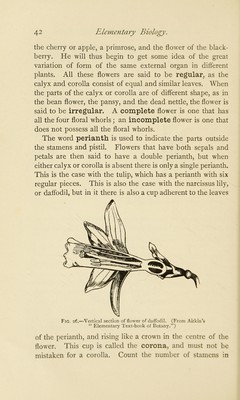
![leaves decay, the harder tissue of the veins remains after the soft part has disappeared, leaving a skeleton outline of the leaf. In most cases the chief veins and veinlets may be well seen on holding the leaf up to the light. Some leaves give rise to cord-like climbing organs called tendrils. Thus the terminal leaflet of the compound leaf of the pea gives rise to a tendril, which often gives off branch tendrils (Fig. 14). Some leaves have no leaf-stalk or petiole, but spring directly from the stem. They are then said to be sessile. The coloured leaves that are arranged in circles or whorls at the end of certain branches of the stem form the flower. As the flower gives rise to the fruit, and is there- fore the organ of reproduction, it will be well to get a clear idea of its main parts at once, using some simple regular flower for an illustration. 16. The Parts of a Flower.—A complete flower in the most fully developed plants consists of a stem, bearing above four successive circles or whorls of variously modified leaves. The flower-stalk is called the peduncle or pedieil, and the leaves forming the flower are crowded together at its upper swollen end, which is termed the receptacle. Pass- ing from the outside of the flower inward, the four whorls of modified leaves are thus named: 1. Calyx, composed of sepals ] These form the perianth, 2. Corolla „ petals J or floral envelope. 3. Androecium „ stamens! These are the essential 4. Pistil „ carpels / parts of the flower. When the leaves composing a whorl are alike, the flower is said to be regular; when the leaves of a whorl vary, the flower is said to be irregular. Generally, but not always, the parts of adjoining whorls alternate, so that a petal comes between two sepals, and a stamen comes between two petals. The calyx and corolla are mainly protective in function.](https://iiif.wellcomecollection.org/image/b28064756_0049.jp2/full/800%2C/0/default.jpg)


 No text description is available for this image
 No text description is available for this image
 No text description is available for this image