Content advisory
This digitised material is free to access, but contains information or visuals that may:
- include personal details of living individuals
- be upsetting or distressing
- be explicit or graphic
- include objects and images of objects decontextualised in a way that is offensive to the originating culture.
Licence: In copyright
Credit: "The molecular structure of the gene". Source: Wellcome Collection.
2/7
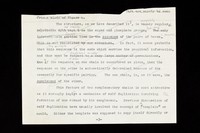
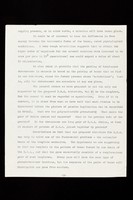
![* The structure, as we ixave described it- 5 , is Mr¿M.y regular# m °* ^ ^ ¿ èépeèr'ctûï? iiM^iADeLgay^^ the sugar and phosphate groupa-f^ Tk^~©»l§r •„ • h .«i lad^e^mTnaTte < seque_nee of tbe^pairs of basest * ' ' -5I]iig.._i%^oir^stHo^ed-In fact, it seems propalale /*r*--t¡ í^v.\N-^*4£» y that this sequence is the code which carries the genetical information, €f¡ MJtyf oi l(tyO) ^ üxm if the sequence^ on one chain is considered as given, then the sequence on the other is automatically determined because of the necessity for specific pairing. The one chain, is, as it were, the complement of the other. This feature of two complementary chains is most attractive ■ j - as it strongly impies a mechanism of self duplication involving formation of one strand by its complement. Previous discussions of m. self duplication have usually involved the concept of ;f template* or mould. Either the template was supposed to copy itself directly or](https://iiif.wellcomecollection.org/image/b18180681_PP_CRI_H_1_12_3_0002.jp2/full/800%2C/0/default.jpg)