Guide to the great fame animals (Ungulata) in the Department of Zoology, British Museum (Natural History) : Illustrated by 53 text and other figures.
- British Museum (Natural History). Department of Zoology.
- Date:
- 1907
Licence: In copyright
Credit: Guide to the great fame animals (Ungulata) in the Department of Zoology, British Museum (Natural History) : Illustrated by 53 text and other figures. Source: Wellcome Collection.
38/152 (page 24)
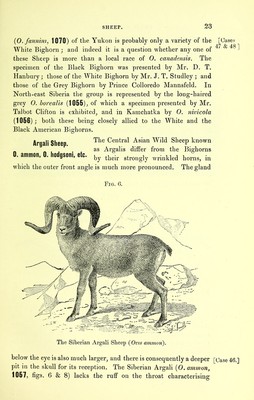
![[Cease 46.] the Tibetan 0. hodgsoni (1058). The former inhabits mountainous country at an elevation of from 3,000 to 4,000 feet, where the slopes are covered with thin forest j but the Tibetan Argali is found at elevations of over 13,000 feet on open and rolling country. Although the old males are very wary and difficult to approach* the females and young males wander in large herds, and exhibit much less wariness. The Siberian Argali is the largest of all the wild Sheep, and has the most massive horns. A mounted specimen in the summer coat, presented by Mr. St. George Littledale, and a head, the gift of Major C. S. Cumberland (fig. 8), as well as numerous skulls, are exhibited. An allied species is Littledale's Sheep (O. littledalei, 1059) of the Kuldja district—represented by a head presented by Mr. Littledale—in which the shape and direction of the horns are different, while the muzzle is white. The Saiar Sheep (O. sairensis, 1080) of the Saiar or Jair Mountains, is a white- muzzled species of smaller size, represented in the collection by three mounted examples shot and presented by Mr. Littledale. Fig. 7. Skull and Horns of Marco Polo’s Sheep {Ovis poll). M nii Mi This magnificent wild Sheep (1061) is nearly Marco Polos Sheep. a ° . r , *7) . . / allied to the Argalis, from which it is mainly Ovis poli. distinguished by the more slender and dis- ease 46.] tinctly angulated horns of the rams, which form a very open spiral (fig. 7), and the colour of the coat. In habits it closely resembles the Tibetan Argali, but it frequents a less barren country than the latter, the undulating Pamirs being covered in summer with luxuriant grass. In Turki the males are called Kulja, or Gulja, and the females Arkar. The somewhat smaller Sheep from the Thian Shan range described as Ovis karelini is only a race of the Pamir species. Marco Polo's Sheep, which is](https://iiif.wellcomecollection.org/image/b2806057x_0038.jp2/full/800%2C/0/default.jpg)