Guide to the great fame animals (Ungulata) in the Department of Zoology, British Museum (Natural History) : Illustrated by 53 text and other figures.
- British Museum (Natural History). Department of Zoology.
- Date:
- 1907
Licence: In copyright
Credit: Guide to the great fame animals (Ungulata) in the Department of Zoology, British Museum (Natural History) : Illustrated by 53 text and other figures. Source: Wellcome Collection.
66/152 page 38
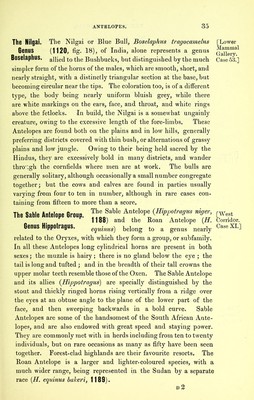
![Somaliland, where they are known by the name of Dibatag. In running, the head and neck are thrown backwards, while the tail is turned forwards over the back. The Gerenuk. The East African Gerenuk, or Waller's Gazelle, Genus Lithocranius walleri (1125, figs. 20-22), differs from Litliocranius. ordinary Gazelles not only by its exceedingly elon- [Case 54.] gated neck and limbs, but likewise by the peculiar hooked form of the very massive horns of the bucks, the dense structure and straight profile of the skull, and the extreme slenderness of the lower jaw. In Somaliland Gerenuk are found in small family-parties, and feed more by browsing on the branches and leaves of trees and shrubs than by grazing. Frequently they raise themselves by standing- on their hind-legs with the fore-feet resting against the trunk of the tree on which they are feeding. Their usual pace is an awkward trot, not unlike that of a Camel; and they seldom break into a gallop. The Beira Antelope. The Beira, Dorcatragus megalotis (1126), of Genus Somaliland and the adjacent districts, is quite Dorcatragus. a small Antelope, which presents many points [Case 54.] of resemblance to the Dik-diks and their allies, although structurally it appears to be more nearly related to the Gazelles. The Blackbuck. As now restricted, the genus Antilope includes Genus only the Blackbuck, or Indian Antelope, Antilope Antilope. cervicapra (1145), a species characterised by the [Case 56.] beautiful spiral twist of the horns of the bucks, and the dark colour of the hair of the upper-parts in adult members of the same sex. The glands below the eyes are very largely developed; and there are tufts of hair on the knees, and lateral hoofs to the feet. Blackbuck are found on the open plains of India, from the foot of the Himalaya nearly to Cape Comorin ; they frequent both grassy districts and corn-lands. Although the usual number in a herd varies from ten to thirty, or fifty—among which there often will be only a single fully adult sable buck—in some cases the assemblage may include hundreds, or even thousands of individuals. These Antelopes possess great speed, and when running frequently progress by a series of long leaps. In many districts they will allow carts, or even men, to approach very close.](https://iiif.wellcomecollection.org/image/b2806057x_0066.jp2/full/800%2C/0/default.jpg)


 No text description is available for this image
 No text description is available for this image
 No text description is available for this image