[Report 1962] / Medical Officer of Health, Dudley County Borough.
- Dudley (England). County Borough Council.
- Date:
- 1962
Licence: Attribution 4.0 International (CC BY 4.0)
Credit: [Report 1962] / Medical Officer of Health, Dudley County Borough. Source: Wellcome Collection.
74/114 page 72
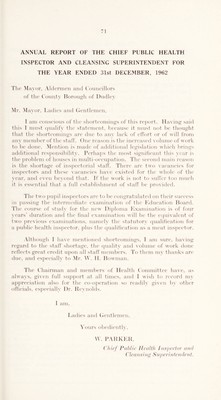
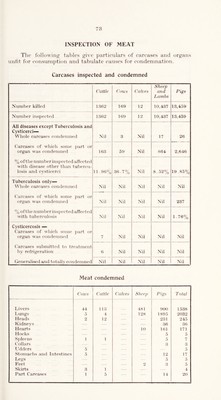
![INSPECTION OF FOOD, SAMPLING OF AND SUPERVISION OF FOOD PREMISES In this section of the report an attempt is made to show what is being done in relation to food on sale to the })opulation and to the ))remises where it is either processed or sold to the pnblie. The first |)oint of emphasis I must make is inade(|uaey of visits because of shortage of staff. There are over 800 food premises in the borough, and it has only been possible to make 898 visits during the year. This is far from satisfaetory, and I hope it will not be long before a decision is taken to fill the staff vaeaneies which have existed for too long. One as})eet of food sup(‘rvision which has received full attention in spite of staff shortage is that of meat inspection. The tables of figures showing number of animals slaughtered and the amount of meat condemned give little idea to the layman of the amount of concentrated attention which this work re(]uires. There are three slaughterhouses in the borough and this in itself, makes for time wastage. The })eriods of slaughter are also staggered, and when one (‘onsiders the annual throughput of animals, some idea of the task can be imagined. As will be seen, the total number of animals in- spected was 25,489. This is ap{)roximately 2()kQ more than last year. Quite a proportion of this secdion of the re})ort is devoted to food sampling. In previous years I have drawn attention to the importance of food labelling, and I make no a})ology for doing so again. Many products are sold by their label and therefore it becomes increasingly more im})ortant to have a system of selective sampling. Perhaps one can describe food offences today as offences of omission in the sense that labels often claim the food to have what is not present rather than the position as it used to be when food was adulterated by the additioi) of ingredients which should not have been there. One hears today the term ''consumer })roteetiou” as though it was a new idea. Public Health ins})eetors have been actively engaged in protecting the consumer of foodstulTs for decades, and will continue so to do. There can be no eomplaeeney when adverse reports on food samples occurred in 22% of the total submitted. Whilst the large ])ercentage of adverse reports can be said to be largely due to in- telligent sam])ling, it is nevertheless disturbing to find the situation as bad as this. Legal proceedings were taken in res})eet of only one type of ])roduet and it is probably the first ease of its kind. In this ease various ehoeolate” covered })roduets were eoneerned, because it was re})orted by the Public Analyst that the ehoeolate covering was, in fact, not ehoeolate.](https://iiif.wellcomecollection.org/image/b29171271_0076.jp2/full/800%2C/0/default.jpg)



 No text description is available for this image
 No text description is available for this image
 No text description is available for this image