Evolution and classification : the reformation of cladism / Mark Ridley.
- Mark Ridley
- Date:
- [1986]
Licence: Attribution-NonCommercial 4.0 International (CC BY-NC 4.0)
Credit: Evolution and classification : the reformation of cladism / Mark Ridley. Source: Wellcome Collection.
35/220 page 23
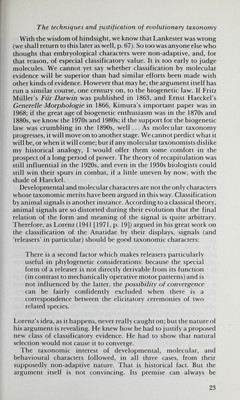
![The techniques and justification of evolutionary taxonomy With the wisdom of hindsight, we know that Lankester was wrong (we shall return to this later as well, p. 67). So too was anyone else who thought that embryological characters were non-adaptive, and, for that reason, of especial classifica tory value. It is too early to judge molecules. We cannot yet say whether classification by molecular evidence will be superior than had similar efforts been made with other kinds of evidence. However that may be, the argument itself has run a similar course, one century on, to the biogenetic law. If Fritz Miiller's Für Darwin was published in 1863, and Ernst Haeckel's Generelle Morphologie in 1866, Kimura's important paper was in 1968; if the great age of biogenetic enthusiasm was in the 1870s and 1880s, we know the 1970s and 1980s; if the support for the biogenetic law was crumbling in the 1890s, well ... As molecular taxonomy progresses, it will move on to another stage. We cannot predict what it will be, or when it will come; but if any molecular taxonomists dislike my historical analogy, I would offer them some comfort in the prospect of a long period of power. The theory of recapitulation was still influential in the 1920s, and even in the 1930s biologists could still win their spurs in combat, if a little uneven by now, with the shade of Haeckel. Developmental and molecular characters are not the only characters whose taxonomic merits have been argued in this way. Classification by animal signals is another instance. According to a classical theory, animal signals are so distorted during their evolution that the final relation of the form and meaning of the signal is quite arbitrary. Therefore, as Lorenz (1941 [1971, p. 19]) argued in his great work on the classification of the Anatidae by their displays, signals (and 'releasers' in particular) should be good taxonomic characters; There is a second factor which makes releasers particularly useful in phylogenetic considerations: because the special form of a releaser is not directly derivable from its function (in contrast to mechanically operative motor patterns) and is not influenced by the latter, the possibility of convergence can be fairly confidently excluded when there is a correspondence between the elicitatory ceremonies of two related species. Lorenz's idea, as it happens, never really caught on; but the nature of his argument is revealing. He knew how he had to justify a proposed new class of classificatory evidence. He had to show that natural selection would not cause it to converge. The taxonomic interest of developmental, molecular, and behavioural characters followed, in all three cases, from their supposedly non-adaptive nature. That is historical fact. But the argument itself is not convincing. Its premise can always be 23](https://iiif.wellcomecollection.org/image/b18021451_0036.JP2/full/800%2C/0/default.jpg)