Evolution and classification : the reformation of cladism / Mark Ridley.
- Mark Ridley
- Date:
- [1986]
Licence: Attribution-NonCommercial 4.0 International (CC BY-NC 4.0)
Credit: Evolution and classification : the reformation of cladism / Mark Ridley. Source: Wellcome Collection.
59/220 page 47
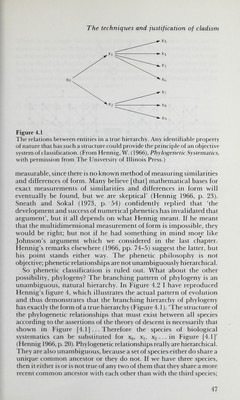
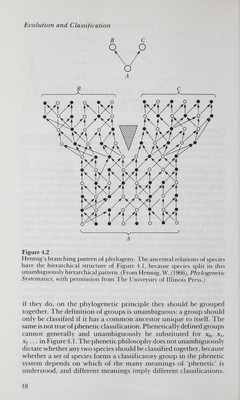
![The techniques and justification of cladism Figure 4.1 The relations between entities in a true hierarchy. Any identifiable property of nature that has such a structure could provide the principle of an objective system of classification. (From Hennig, W. (1966), PhylogeneticSystematics, v^'ith permission from The University of Illinois Press.) measurable, since there is no knovs^n method of measuring similarities and differences of form. Many believe [that] mathematical bases for exact measurements of similarities and differences in form will eventually be found, but we are skeptical' (Hennig 1966, p. 23). Sneath and Sokal (1973, p. 54) confidently replied that 'the development and success of numerical phenetics has invalidated that argument', but it all depends on what Hennig meant. If he meant that the multidimensional measurement of form is impossible, they would be right; but not if he had something in mind more like Johnson's argument which we considered in the last chapter. Hennig's remarks elsewhere (1966, pp. 74-5) suggest the latter, but his point stands either way. The phenetic philosophy is not objective; phenetic relationships are not unambiguously hierarchical. So phenetic classification is ruled out. What about the other possibility, phylogeny? The branching pattern of phylogeny is an unambiguous, natural hierarchy. In Figure 4.2 I have reproduced Hennig's figure 4, which illustrates the actual pattern of evolution and thus demonstrates that the branching hierarchy of phylogeny has exactly the form of a true hierarchy (Figure 4.1 ). 'The structure of the phylogenetic relationships that must exist between all species according to the assertions of the theory of descent is necessarily that shown in Figure [4.1] ... Therefore the species of biological systematics can be substituted for Xq, x^, Xg ... in Figure [4.1]' (Hennig 1966, p. 20). Phylogenetic relationships really are hierarchical. They are also unambiguous, because a set of species either do share a unique common ancestor or they do not. If we have three species, then it either is or is not true of any two of them that they share a more recent common ancestor with each other than with the third species; 47](https://iiif.wellcomecollection.org/image/b18021451_0060.JP2/full/800%2C/0/default.jpg)