Report on the sanitary administration of the Punjab and proceedings of the Sanitary Board for the year ... and the report on sanitary works for.
- Punjab (India). Sanitary Board.
- Date:
- [1877]
Licence: Public Domain Mark
Credit: Report on the sanitary administration of the Punjab and proceedings of the Sanitary Board for the year ... and the report on sanitary works for. Source: Wellcome Collection.
124/276 (page 103)
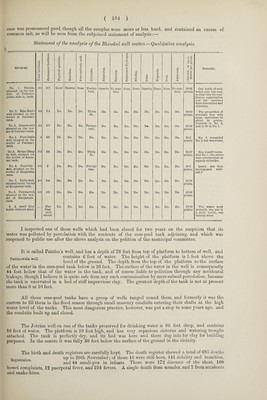
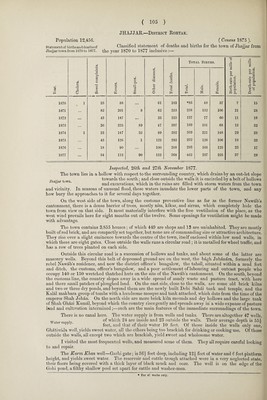
![The town contains altogether 9,899 houses; of these 2,526 are masonry dwellings, shops, and store-houses, and 7,373 are thatched huts and tiat-roofed mud-built houses. There are besides some hundreds of Hindu temples. The residents are almost entirely Hindus, and are wholly engaged in trade, sending Sambhar salt to the NorthWest Provinces, and sugar thence to Bikaner and Jaisiltnir. The trade of the place has considerably fallen off since the opening of the East Indian Railway, and the recently opened Rajputana line has still more reduced it, and now it is said to be steadily on the decline. The town lies in a hollow, and is most disadvantageous^ situated in point of drainage. In fact it is found impracticable to get the storm waters out of its own area, and they are, with the ordinary liquid sewage of the town, received into wide and deep excavations or tanks, of which there are six devoted to this purpose at different spots within the intramural area. The main bazfirs and streets are wide and airy, and conduct to the several gates of the town, of gt t which there are twelve. The roadways are for the most part metalled, and provided with capacious open drains of masonry at each side, but the place of these in some parts of the enclosed suburb area is taken by deep ditches. These last are in course of being gradually filled in and levelled up as funds become available, but the process seems a slow one, and meanwhile they are kept as clean as is practicable. The side streets and alleys are generally unpaved and undrained, though in some of them a brick pavement has been recently laid down. It is, I understand, intended to pave others in the same way as funds become available. In those already laid down, the surface slopes from the sides to a shallow gutter running down the middle line, and the sewage from private houses on each side flows broadcast across the pavement to this central gutter. This is a serious defect and should be remedied. A slight slope from the centre to a line of gutter on each side would at once correct the evil. I found the town generally clean, and its conservancy well looked after by the municipal authorities, who have unusual difficulties to contend against, owing to the disadvantageous situation of their town. There are altogether 27 public latrines here. Twelve of them are for men, and are situated outside the walls at convenient distances from its several gates ; and fifteen Latrmes. are £or womeilj anq are a]} situated on open spaces inside the walls. They are on the same general plan as those before described, and require to be roofed, and furnished with proper utensils. I found them in good order and well tended. The soil is trenched in the vicinity of those outside the walls, and these trenches also receive the sewage of the town which is brought out in barrel carts. Street sweepings and such rubbish is carted out and shot on the surface at appointed sites at some distance from the town. It would be an improvement to limit these sites within low walls, as much to restrict the rubbish area as to preserve the manure material. There is no canal here. The water supply is from wells and tanks on the sides of which they are sunk. There are altogether 204 wells, of which only 15 or 16 are Water supply. outside the walls. The depth of the water from the surface of the ground is from 60 to 70 feet, and its depth in the wells from 6 to 16 feet. Of all these wells only 55 yield sweet and wholesome water, and they are clustered in groups of three or four about the edges of the principal tanks. They are all inside the walls, except the Nimla tank group situated on the plain to the west, and near the site of a boring for an Artesian well now in course of progress. All the other wells are brackish and unfit for drinking purposes. There are nine tanks inside and four outside the walls. They are wide, and very deep excavations in the soil, and between the wells lining them have broad flights of masonry Tanks- steps. Three of those inside the walls, and the Nimla tank outside, are preserved for drinking purposes by a protecting wall, and a chaukidar as guard to keep oft cattle and prevent people bathing or washing clothes, &c., in them. They are filled in the rains by the surface drainage of the surrounding vicinity, which is led into them through masonry conduits in their sides. The collecting grounds are to some extent laid out in plots of cultivation, and thus in a measure protected from the ordinary sources of surface contamination. I found these tanks perfectly dry, and presenting clean hard clay bottoms. The other six tanks within the intramural area are mere cess-pools of great size and depth. They receive all the street drainage, and much of the liquid sewage of the town, and as I saw them contained small seas of filthy liquid resting on a bed of black muck, which was stirred up here and there by buffaloes floundering in them. Nevertheless I found a number of washermen at work washing clothes in this filthy stuff at only a few paces distance from the buffaloes, and on drawing the attention of some of the members of the municipal committee who were with me to the sight, merely elicited the excuse—“ What else are they to do? It is the only place they have for the purpose.” And this with about 150 wells in the place not used for drinking purposes! The use of these cess-pools by washermen should be at once peremptorily prohibited. In July last year, a qualitative analysis of the water of eight of the principal wells of this town was made by the Chemical Examiner, Lahore, and the physical quality in each](https://iiif.wellcomecollection.org/image/b31489230_0124.jp2/full/800%2C/0/default.jpg)