Translation of the Pharmacopoeia of the Royal College of Physicians, of London, 1851 : with notes and illustrations / by Richard Phillips.
- Royal College of Physicians of London. Pharmacopoeia Londinensis. English
- Date:
- 1851
Licence: Public Domain Mark
Credit: Translation of the Pharmacopoeia of the Royal College of Physicians, of London, 1851 : with notes and illustrations / by Richard Phillips. Source: Wellcome Collection.
Provider: This material has been provided by King’s College London. The original may be consulted at King’s College London.
101/596 page 79
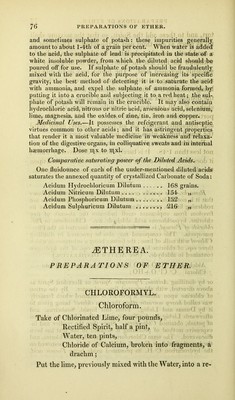
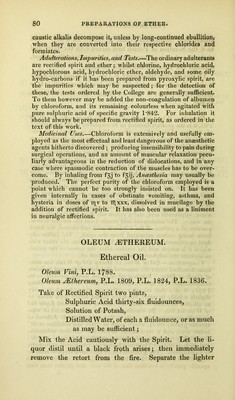
![pochlorite, into six eqs. of carbonate of lime, which combine with the chloride of calcium, forming a brilliant arenaceous powder. The subjoined diagrams may further elucidate these complex reactions:— [2] Alcohol=C8 H1204 | r [8] Hypochlo- rite of Lime = 016Cl8Ca8. ^ C4H O2 C4H202-^ H9 1 / Chloral C4H O2 TT9 fl9 Cl3 [1] [9] Ca2[2] Ca [1] o9 j CF - O6 Ca2^ A A. Formiate ] of Lime J k4H2 O8 A u t,a —-—Chloride u 1 Cl5 Ca5 of Calcium \ Cl6Ca5[5] C8Hi2O20Q8Ca8. C8H12O20Cl8Ca8. C8H12O20Cl8Ca8. The chloral, lime, and one eq. of the water are again de- composed :— [1] Chloral=C4H [l]Water = H [l]Lime = 02C13. | O. 0 Ca. C2 H Cl3- C2 021 HO/ 0 = Formic Acid Ca- TERCHLORIDEpgu of Formyl Formiate of £2tt q4 Lime. Cl3 [l] Ca [1] C4H204Cl3Ca. C4H204Cl3Ca. C4H204Cl3Ca. Chloroform, or Terchloride of Formyl, thus prepared is com- posed of Two equivalents of Carbon 6x2= 12 or 9*92 One „ of Hydrogen 1 „ *66 Three „ of Chlorine 36x3 = 108 „ 89*4-2 Equivalent 121 100* Formula C2 H Cl3. Properties.—It is a transparent, colourless, oleaginous-looking liquid, possessing a specific gravity of 1*48 to 1*5, very volatile, and when pure, of a cool sweet taste, and fragrant ethereal smell. It is very slightly soluble in water, but dissolves in alcohol and ether; it readily dissolves camphor, caoutchouc, amber, copal, and the gum-resins ; it is also a solvent for iodine and bromine, both of which it will withdraw from their aqueous solutions; it is also stated to dissolve wax, phosphorus, and sulphur. It boils at 141°; it is but slightly inflammable, although it will burn, producing a greenish-coloured flame when ignited. Sulphuric acid has no immediate action on chloroform, but this acid appears to impart to this substance a tendency to decomposition. Nitric acid slowly decomposes it, but nitrate of silver exerts no action upon it, more than imparting a cloudiness, similar to that produced in it when not quite free from alcohol by dropping it into water. Potassium excites but slight action upon chloroform, nor do the](https://iiif.wellcomecollection.org/image/b21308184_0105.jp2/full/800%2C/0/default.jpg)



 No text description is available for this image
 No text description is available for this image
 No text description is available for this image