Translation of the Pharmacopoeia of the Royal College of Physicians, of London, 1851 : with notes and illustrations / by Richard Phillips.
- Royal College of Physicians of London. Pharmacopoeia Londinensis. English
- Date:
- 1851
Licence: Public Domain Mark
Credit: Translation of the Pharmacopoeia of the Royal College of Physicians, of London, 1851 : with notes and illustrations / by Richard Phillips. Source: Wellcome Collection.
Provider: This material has been provided by King’s College London. The original may be consulted at King’s College London.
132/596 page 110
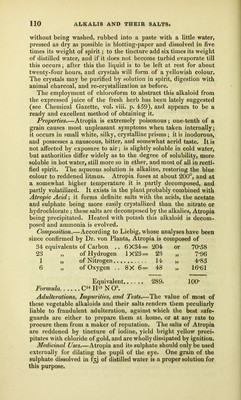
![without being washed, rubbed into a paste with a little water, pressed as dry as possible in blotting-paper and dissolved in five times its weight of spirit; to the tincture add six times its weight of distilled water, and if it does not become turbid evaporate till this occurs; after this the liquid is to be left at rest for about twenty-four hours, and crystals will form of a yellowish colour. The crystals may be purified by solution in spirit, digestion with animal charcoal, and re-crystallization as before. The employment of chloroform to abstract this alkaloid from the expressed juice of the fresh herb has been lately suggested (see Chemical Gazette, vol. viii. p. 459), and appears to be a ready and excellent method of obtaining it. Properties.—Atropia is extremely poisonous; one-tenth of a grain causes most unpleasant symptoms when taken internally; it occurs in small white, silky, crystalline prisms; it is inodorous, and possesses a nauseous, bitter, and somewhat acrid taste. It is not affected by exposure to air; is slightly soluble in cold water, but authorities differ widely as to the degree of solubility, more soluble in hot water, still more so in ether, and most of all in recti- fied spirit. The aqueous solution is alkaline, restoring the blue colour to reddened litmus. Atropia fuses at about 200°, and at a somewhat higher temperature it is partly decomposed, and partly volatilized. It exists in the plant probably combined with Atropic Acid; it forms definite salts with the acids, the acetate and sulphate being more easily crystallized than the nitrate or hydrochlorate; these salts are decomposed by the alkalies, Atropia being precipitated. Heated with potash this alkaloid is decom- posed and ammonia is evolved. Composition.—According to Liebig, whose analyses have been since confirmed by Dr. von Planta, Atropia is composed of 34 equivalents of Carbon .. 6X34= 204 or 70-58 23 of Hydrogen 1X23= 23 » 7*96 1 of Nitrogen.. . 14 » 4-85 6 of Oxygen .. 8X 6= 43 „ 16-61 Equivalent 289. 100- Formula C34 Ha3 N O6. Adulterations, Impurities, and Tests.—The value of most of these vegetable alkaloids and their salts renders them peculiarly liable to fraudulent adulteration, against which the best safe- guards are either to prepare them at home, or at any rate to procure them from a maker of reputation. The salts of Atropia are reddened by tincture of iodine, yield bright yellow preci- pitates with chloride of gold, and are wholly dissipated by ignition. Medicinal Uses.—Atropia and its sulphate should only be used externally for dilating the pupil of the eye. One grain of the sulphate dissolved in i'5] of distilled water is a proper solution for this purpose.](https://iiif.wellcomecollection.org/image/b21308184_0136.jp2/full/800%2C/0/default.jpg)


 No text description is available for this image
 No text description is available for this image
 No text description is available for this image