Translation of the Pharmacopoeia of the Royal College of Physicians, of London, 1851 : with notes and illustrations / by Richard Phillips.
- Royal College of Physicians of London. Pharmacopoeia Londinensis. English
- Date:
- 1851
Licence: Public Domain Mark
Credit: Translation of the Pharmacopoeia of the Royal College of Physicians, of London, 1851 : with notes and illustrations / by Richard Phillips. Source: Wellcome Collection.
Provider: This material has been provided by King’s College London. The original may be consulted at King’s College London.
75/596 page 53
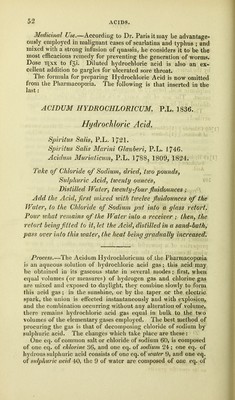
![hydrogen 1. and one eq. of oxygen 8. When the salt, water, and acid act upon each other, the changes that occur are the follow- ing : the chloride and water are both decomposed, the 36 of chlo- rine yielded by the former unite with the 1 of hydrogen supplied by the latter, and form 37 of Hydrochloric Acid Gas, while the 24 of sodium combining with the 8 of oxygen, constitute 32 of oxide of sodium or soda, and these combining with the 4-0 ot sulphuric acid, form 72 of sulphate of soda, which remains in the retort. The use of the water with which the sulphuric acid is diluted will be presently stated. The annexed diagram will explain the reactions above de- scribed : [1]60 Chloride f [1] Chlorine 36 of Sodium. \ [1] Sodium 24 [1]49 Hydrous f [1 '[Water... Sulphuric*! [1J Sulphuric Acid. [ Acid... 40 109 109 37 Hydrochloric Acid [1J. 72 Sulphate of — Soda [1]. 109 Properties.—Hydrochloric Acid Gas is colourless and invisi- ble; at common temperatures and under the usual pressure, it is permanently elastic; when, however, at the temperature of 50°, it is subjected to a pressure of 40 atmospheres, it is rendered li- quid ; but when the pressure is removed, it immediately reassumes the gaseous state. Hydrochloric acid gas has a pungent odour, an acid and acrid taste, and is quite irrespirable and uninflam- mable ; it reddens litmus paper strongly, and evinces all the other properties of a powerful acid. It has great affinity for water, when it escapes into the air combining with its moisture so as to form a white vapour, and yielding dense white fumes when ex- posed to ammoniacal vapours; a few drops of water introduced into a jar of the gas immediately causes its absorption. Water at 40° is capable of dissolving nearly 480 times its bulk of this gas. It is not altered by heat, but by electricity it is partially de- composed. When this acid is required in its gaseous state, it must, ou account of its ready solubility in water, be received in glass jars filled with and inverted in mercury. Composition.—It has been already observed that this compound gas consists of equal volumes of its elementary gases, and 50 cubic inches of Hydrogen gas weigh 1*075 grs. 50 cubic inches of Chlorine gas 38*700 — 100 cubic inches of Hydrochloric Acid gas weigh.. 39*775 grs. Its specific gravity is 1*2830, air = l. Berzelius gives 1*2546 as its specific gravity.](https://iiif.wellcomecollection.org/image/b21308184_0077.jp2/full/800%2C/0/default.jpg)



 No text description is available for this image
 No text description is available for this image
 No text description is available for this image