Translation of the Pharmacopoeia of the Royal College of Physicians, of London, 1851 : with notes and illustrations / by Richard Phillips.
- Royal College of Physicians of London. Pharmacopoeia Londinensis. English
- Date:
- 1851
Licence: Public Domain Mark
Credit: Translation of the Pharmacopoeia of the Royal College of Physicians, of London, 1851 : with notes and illustrations / by Richard Phillips. Source: Wellcome Collection.
Provider: This material has been provided by King’s College London. The original may be consulted at King’s College London.
86/596 page 64
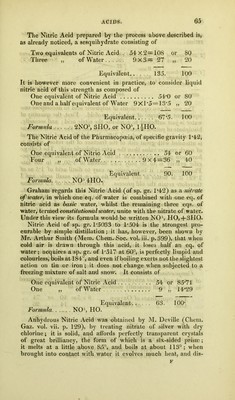
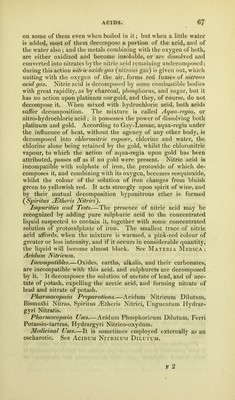
![annexed diagram will further explain the nature of the ope- ration ; [2]204 Nitrate of f [2] Nitric* Potash i [2^\ Potash [4] 205 Hydrous Sulphuric) Acid. 409 {[5] Nitric Acid 108 96 27 Water r j-1 Sulphuric l*]Acid 409 135 SeSQUIHVDRATED Nitric Acid [2]. 274 Hydrated Bisul- phate of Potash [2]. 409 The use of two equivalents of sulphuric acid to decompose one equivalent of nitrate of potash is twofold. First, the quantity of water is just sufficient to condense the nitric acid ; and secondly, bisulphate of potash is readily dissolved out of the retort, whereas neutral sulphate is a salt of difficult solubility, and its removal is attended with great risk of the fracture of the retort, which is of much greater value than the extra sulphuric acid. The College have now placed nitric acid in the Materia Medica, and its spe- cific gravity is to be only 1*42 instead of 1*50, as in the late Pharmacopoeia; it being quite as easy to distil acid of 1*5 as of 1 *42; it is better at any rate to do so on the small scale, and I therefore retain the old process. The nitric acid of 1*5 contains 80 per cent, of real acid, and that of 1*42 only 60 per cent., the former may therefore be reduced to the latter by adding 100 parts of it by weight to 34 of distilled water; this order of mixing should be observed, as considerable heat is evolved. If it be preferred, the proper quantity of water might be mixed with the sulphuric acid, and nitric acid of 1*42 obtained at once. As the nitric acid obtained in this operation consists of two equivalents of acid combined with three of water, it is evidently a sesquihydrate, or consists of one equivalent of acid combined with one and a half equivalent of water, and this is I believe the strongest procurable by simple distillation. Before I describe its properties I shall state the composition of nitric acid. Composition.—Anhydrous Nitric Acid, as it exists in nitrate of potash and other anhydrous nitrates, and as it may be prepared in a mode I shall presently mention, consists of Five equivalents of Oxygen .... 8 x5 = 40 or 74 One „ of Nitrogen.... 14 .. .. 26 Equivalent.... 54 100 Formula NO5. Or it may be considered as composed of Five volumes of Oxygen Gas. Two volumes of Nitrogen Gas.](https://iiif.wellcomecollection.org/image/b21308184_0090.jp2/full/800%2C/0/default.jpg)



 No text description is available for this image
 No text description is available for this image
 No text description is available for this image