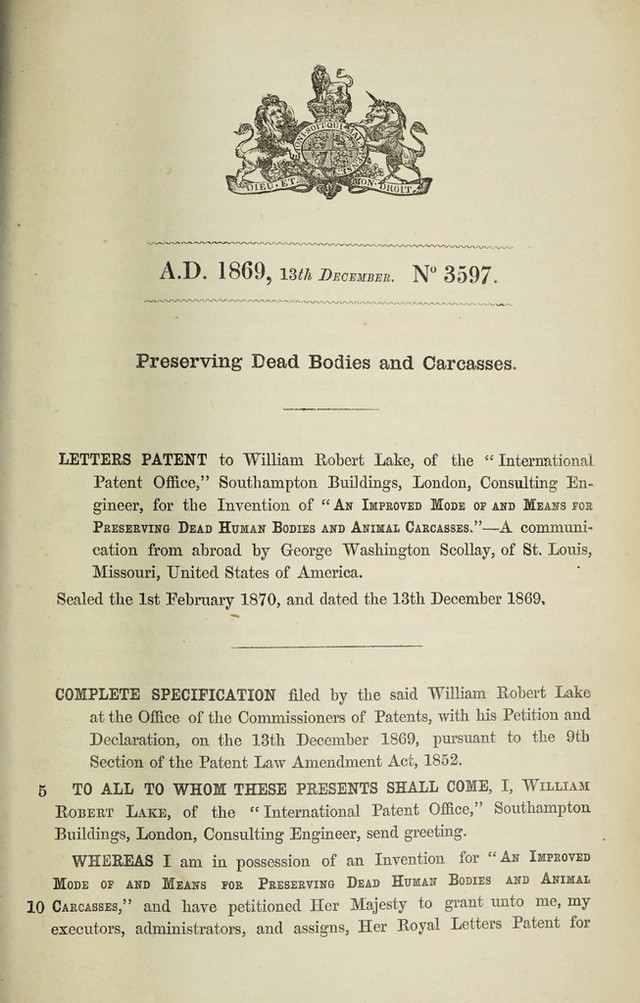
Specification of William Robert Lake : preserving dead bodies and carcasses.
- Lake, William Robert.
- Date:
- 1870
Licence: Public Domain Mark
Credit: Specification of William Robert Lake : preserving dead bodies and carcasses. Source: Wellcome Collection.
5/10 page 3
![Specification. A.D. 1869.—N° 3597. 3 Lake s Improved Mode of Preserving Dead Bodies and Carcasses. body or carcass after death will restore the life-like color of the venous blood and consequently the tissues and substance of the body or carcass and that this is especially true of that class of gases which are com¬ bustible or will support combustion. By uniting these gases or vapors 5 which may or may not be antiseptic, with gases that are highly Inti- septic, in or on the body in combination with a neutral salt or saline or alkaline influence applied to the body or carcass, I can not only preserve the body, but I can also restore and preserve uniformly the life-like color of the entire human body and the fresh juicy appearance of the 10 flesh of the animal carcass. In practising this Invention to accomplish the objects aforesaid I proceed as follows, that is to say:—I make first either an alakine, saline, or neutral solution, consisting of water and sulphite of soda or potash in the proportion of about ten ounces of water to from five to 15 eight of sulphite of soda or potash, adding enough soda to give the solution an alkaline preponderance; X then make a combination in a suitable retort of sugar and sulphuric acid in the proportion of about three fluid ounces of the acid to one half ounce of sugar; X then, take about twenty ounces of the alkaline or neutral solution, and put it into a 20 suitable vessel or retort supplied with a small flexible tube fitted with a beak of hard rubber, non-corrosive metal or ivory, this retort containing the alkaline or neutral solution; X then connect to the retort containing the mixture of sulphuric acid and sugar; X then make a small incision in the tibia], radial, or any convenient artery of the body or carcass, and 25 insert the beak of the tube; X then put a lamp under the retort con¬ taining the sugar and acid, and generate the gases in combination in sufficient quantities to drive the solution through the tube (the end of which must be immersed to the bottom of the solution) into the arterial and venous system, and afterwards allow the gas or gases to follow the 30 fluid into the body until the sugar and acid have been depleted of their gases or until enough of the gases have entered the vascular and nervous system to neutralize the alkaline excess of the solution and to insure the preservation of the body. The result of this process wrill be, first, a complete preservation of the 35 body against putrefaction; and second, the obtaining or restoring and maintaining the uniform life-like colour and juicy appearance of the body and flesh and its soft flexible consistency for comparatively a long period of time or until the fluids of the body have evaporated and the](https://iiif.wellcomecollection.org/image/b3075284x_0005.jp2/full/800%2C/0/default.jpg)