Volume 2
Chemistry, theoretical, practical, and analytical : as applied and relating to the arts and manufactures / by Dr. Sheridan Muspratt.
- James Sheridan Muspratt
- Date:
- [1860]
Licence: Public Domain Mark
Credit: Chemistry, theoretical, practical, and analytical : as applied and relating to the arts and manufactures / by Dr. Sheridan Muspratt. Source: Wellcome Collection.
142/644 page 98
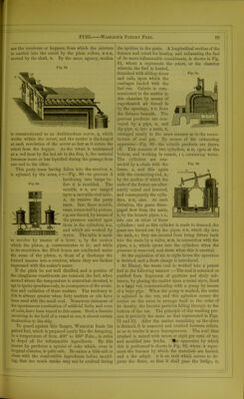
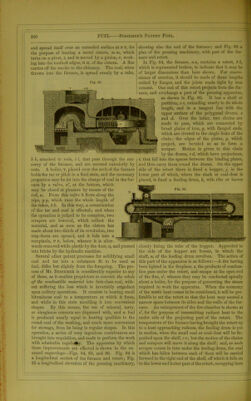
![therein submitted to pressure by means of a heavy log or beam of wood, which carries pistons that work Fig. 77. into those frames. In the above figure, tire beam is represented by A B moving on the uprights, G h, g h, which keep it in its place by the eccentric motion com- municated to the rods, I j, I j; a, i, c, d, e, indicate the pistons which press the material in, and discharge it from the moulds,/,/,/,/,/. Two women are con- stantly employed in filling the moulds; and whilst the one set are being pressed and discharged by the pistons, a, c, e, the others are replenished. When the beam, a b, is raised, the filled moulds are brought under the pistons by a horizontal motion communicated to the casting, e e, by the pinion and wheel, L, k ; on the descent of the beam, these are in turn discharged, the others being filled in the meantime, and the motion of E E reversed. In this way the operation of moulding goes on without interruption. An equivalent of six horse-power is required to work this machine, but with it one man and four women can produce about four hundred and fifty bushels of the fuel in a day. After the moulding, the next operation to which the material is subjected is the drying, which is merely an exposure of from two to three days to a current of air. The carbonization of the bricks is effected in a kind of muffle furnace, shown partly in section, and partly Fig. 78. i i elevation, in Fig. 78. The muffle in this furnace is about four and a half inches thick of refractory moterial. It is heated by a fire at n, the flame from which circumscribes the whole of the muffle. The ] products of combustion pass behind the muffles by the ' channel, c J>, but return to the front by the flue, E, and ultimately depart by the openings, ff into the sub- terranean channels, g g, leading to the chimney at the back. The bricks or moulds, which are generally four and a half inches in length, by one and a half in diameter, are packed in the carbonizers. which may be sheet-iron boxes, H u ij, or cast-iron cylinders, in; these are fixed on tracks, to facilitate their intro- duction and withdrawal from the muffle by a door in front of the case, lined with firebrick and refractory clay, which may be opened and shut at will. This door is shown at k, and when the carbonization is proceeding, all crevices in it are carefully stopped by clay luting. The first effect of the heat is to eliminate moisture from the charring mass; this is followed by 6ome carbides of hydrogen, all of which escape from the cylinders or boxes by small apertures, about the time that the cylinders are beginning to become red-hot Air is then admitted cautiously at M. m, whereby the evolved gases are burned, giving out as much heat as is sufficient to complete the operation. By having a series of eight muffles and C3rlinders, two may be charged every six hours, the material being charred in a day. Wien no more flame is observed in the space, c, examined through m, the workman knows that the charring is completed, and the cylinders are then with- drawn. Waste cuttings, brushwood, and such materials as could not be employed in the manufacture of ordi- nary charcoal, may be carbonized, and then turned to profitable account in the manner just described. The same principle is developed in the manufacture of patent fuel from refuse coal or slack, and also from the waste matter of the coke ovens. In either case, it is necessary to mix them with substances which will give a sufficient consistency to the mass, to cause the particles to adhere whilst coking or burning in the open or furnace grate. In selecting the cementing materia], there are some who do not confine themselves to olea- ginous, fatty, or tarry matters, but employ also loam, hydrate and sulphate of lime, and various other mineral substances, whilst others—and doubtless this is the best course to adopt—discard the use of all such bodies; and, by a judicious admixture of two varieties of coal, or by operating upon the coal in a particular way, cause it to adhere, and so bring it into such a form as will admit of its being burned as ordinary fuel, or coke. The most important of the patent fuels will here be alluded to. Wylam directs, in his patent for the manu- facture of artificial fuel, that small coal be mixed •uth pitch, and the compound afterwards moulded. The proportions in which these ingredients are taken, are four parts of slack to one of pitch. By means of edge stones, or other machinery, the pitch and coal are ground together, or otherwise mixed, and the mass is put into a large hopper, from which it passes into a retort. This arrangement is seen in Fig. 79, where M M](https://iiif.wellcomecollection.org/image/b28121132_0002_0142.jp2/full/800%2C/0/default.jpg)
 No text description is available for this image
 No text description is available for this image
 No text description is available for this image