Volume 2
Chemistry, theoretical, practical, and analytical : as applied and relating to the arts and manufactures / by Dr. Sheridan Muspratt.
- James Sheridan Muspratt
- Date:
- [1860]
Licence: Public Domain Mark
Credit: Chemistry, theoretical, practical, and analytical : as applied and relating to the arts and manufactures / by Dr. Sheridan Muspratt. Source: Wellcome Collection.
168/644 (page 124)
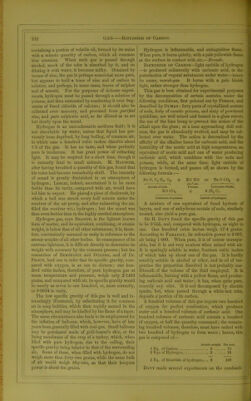
![GAS Carbonic Oxide—Cyanogen. Marchand states that one volume of olefiant gas requires, for perfect combustion, three of oxygen. When sulphur is heated in one volume of this gas, j charcoal separates, and two volumes of sulphide of | hydrogen result. As hydrogen suffers no change of volume by combining with sulphur, it follows that ole- fiant gas contains two volumes of hydrogen condensed into one; hence the quantity of oxygen required for its combustion. This compound is also decomposed by heat alone, as by passing and repassing it through a red-hot tube of earthenware or metal; it then gradu- ally deposits its carbon, and is ultimately expanded into twice its original volume of pure hydrogen. An ana- logous transformation of the olefiant gas generated in tire retorts of the gas-works is observed, and is con- nected with the deposition of several interesting forms of carbon. When one volume of olefiant gas is detonated by the electric spark in a proper tube—which, on account of the violence of the explosion, should be very strong— with three volumes of oxygen, two of carbonic acid are formed, and water is deposited. Now two volumes of carbonic acid contain two of oxygen, so that the other volume of oxygen must have condensed two of hydro- gen to form water. Hence one equivalent or volume of olefiant gas must contain two equivalents of carbon and two of hydrogen.—Brande. Volatile Hydrocarbons.—Next in order, among the constituents of coal-gas, are the volatile hydro- carbons, portions of which vaporize at a heat much below that of boiling water; consequently, parts of them are carried off by the coal-gas—the quantity found in the gas varying with the distance from the works in which it is generated. Benzol contains ninety-two per cent, of carbon, a far greater amount than even olefiant gas. When it is burned with an insufficient supply of oxygen, large deposits of carbon ensue. With a proper quantity of oxygen, this hydrocarbon affords a beautiful light, as may be observed when a stream of atmospheric air is transmitted through it during ignition. The peculiarly rich and illuminating power of the vapor of benzol, may be seen by passing it through the pale and almost invisible flame of hydrogen. This substance has been fully described in VqI. I,, page 285, et sequitur. Carbonic Oxide, which is rather an impurity than a proper constituent of coal-gas, may be very readily obtained, as Brande remarks, by Dumas’ process, which consists in gently heating oxalic acid with five or six times its weight of sulphuric acid; the mix- ture effervesces in consequence of the evolution of equal volumes of carbonic oxide and carbonic acid gas ; the latter may be abstracted by a caustic alkaline solution, and pure carbonic oxide gas remains. In this case, the evolution of the two gases is caused by the abstraction of water from oxalic acid, which contains, in its anhydrous state, the elements of one equiva- lent of carbonic oxide, and one of carbonic acid; but these can only exist as oxalic acid when in union with water, or with a base, anhydrous oxalic acid not having been isolated. Crystallized oxalic acid is C203, 3 HO, which, acted upon by three equivalents of sulphuric acid, 3 (HO, S 03), becomes 3 (2 HO, S 03) + C02+C0; the hydrated sulphuric acid remains in the retort, the carbonic acid is abstracted by passing the gases through a solution of caustic potassa, and the carbonic oxide I passes off’. Another source of carbonic oxide, suggested j by Fownes, is the action of ten parts of concentrated ! S sulphuric acid on one part of pulverized crystals of ' ferrocyanide of jKitassium; the gas thus obtained is i pure, and is evolved in the proportion of three hundred cubic inches from half an ounce of the salt. Ferrocyanide of potassium contains cyanide of po- ; tassium, K C2 N, and cyanide of iron, Fe C2 N ; they j are converted by the sulphuric acid into sulphates of j iron and potassa, sulphate of ammonia, and carbonic ] oxide; thus, in regard to the cyanide of potassium, K C2 N + Cyanide of potassium. KO, S03 + Sulphate of potas9a. It not unfrequently happens that carbonic oxide is | formed by the combustion of carbon when the supply ( of oxygen is inadequate to the production of carbonic • acid; hence the lambent blue flame which sometimes ] plays upon a coke or charcoal fire, or is seen to issue ; from certain furnaces: this is, in fact, equivalent to ;j passing carbonic acid over red-hot charcoal; so that C Os -f C becomes 2 C 0. The specific gravity of this gas compared to hydrogen is as fourteen to one ; and to atmospheric air as 09706 * to l'OOOO ; a hundred cubic inches weighing 290979 | grains. It is very fatal to animals, causing giddi- j ness and fainting when respired mixed with atmo- -i spheric air. When breathed pure, it almost immediately i produces profound coma. It extinguishes flame, and | bums with a peculiar blue light when mixed with, or ( exposed to, atmospheric air. Davy found that the 1 temperature of an iron wire heated to dull redness was ( sufficient to inflame it. It has no taste and little odor; ; it does not affect vegetal colors, occasions no precipi- < tate in lime water, and is very sparingly absorbed by ' water which has been deprived of air. When burned j in dry air or oxygen under a bell-glass, no moisture « whatever is deposited, showing that hydrogen is not - contained in this gas. Carbonic acid is the only result ? of this combustion.—Brande. No change is effected in carbonic oxide when it is passed and repassed through a red-hot porcelain tube; l nor is it altered at high temperatures by phosphorus, sulphur, nor even, according to the experiments of :i Sacssure, by hydrogen, though it is stated upon other authorities, that at elevated temperatures hydrogen j does decompose it. Cyanogen.—There is no class of organic bodies, •: remarks Sir Robert Kane, of which there is more • extensive and exact knowledge, than those which ^ have cyanogen as their basis. The powerful affinities { which this radical exerts, the simplicity of its consti- | tution, and above all, the circumstance that one is able | to prepare it in an isolated state, and to generate its compounds directly from it, as from those of a truly simple body, renders its history the most advanced portion of organic chemistry, and that to which the 2 (HO, 80s) Sulphuric arid. N H4 0, S08 Sulphate of amn*otiLa- + 2 HO = W*J*r + 2 CO. CurUtdc oxide-](https://iiif.wellcomecollection.org/image/b28121132_0002_0168.jp2/full/800%2C/0/default.jpg)