Volume 2
Chemistry, theoretical, practical, and analytical : as applied and relating to the arts and manufactures / by Dr. Sheridan Muspratt.
- James Sheridan Muspratt
- Date:
- [1860]
Licence: Public Domain Mark
Credit: Chemistry, theoretical, practical, and analytical : as applied and relating to the arts and manufactures / by Dr. Sheridan Muspratt. Source: Wellcome Collection.
56/644 page 12
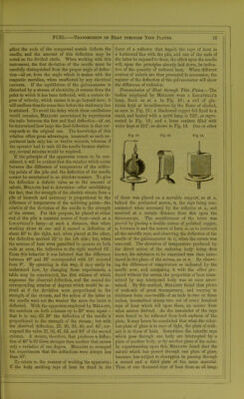
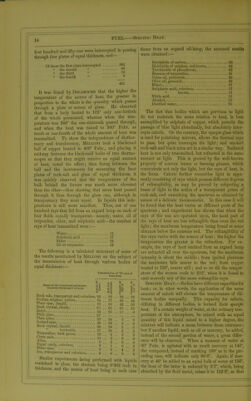
![metal be suspended in a room for Romo time, the excess of calorie contained in it will pass oil' in all directions, and tho metal ultimately indicates only the same temperature as the surrounding objects. During the cooling, the heat passes oil’ at all points of the body in direct lines as from a centre—hence the term radi- ated. To prove that convection and radiation are dis- tinct processes, and that the latter is not a consequence of the former, all that is necessary is to expose a heated body in the vacuum of an air-pump, in which case it will be observed that the emission of caloric is much quicker even than if it were allowed to cool in contact with the air. In simple language, the rate of cooling expresses the radiating power; and Leslie ascertained that the radiating power of bodies was more influenced by the state of their surface than by the nature of the material. A bright tin globe filled with water at a certain tem- perature was allowed to cool, and the time being care- fully noted, it was found that the contents of the vessel cooled half way to the temperature of the room, in one hundred and fifty-six minutes. When the same experi- ment was repeated with the surface of the globe coated with lamp-black, it was observed that the mercury in the thermometer fell through the same space as it did in the first experiment in eighty-one minutes: thus showing, that by the alteration of the surface the radi- ating power was doubled. Count Rumford corro- borated this observation by another experiment. Tak- ing two brass cylinders of equal size and capacity, and investing one of them tightly with linen, while the other was left bare, he filled the two with boiling water, and allowed them to cool. During this process, he observed that the coated cylinder lost 10° of its original temperature in thirty-six minutes and a half, while the other required fifty-five minutes to pass through an equal range. Hence may be deduced the important practical inference, that liquids are best kept warm in highly polished vessels, and that it is an error to wrap them round with cloths or other coverings, which radiate the heat more rapidly than polished metals. By following the method of Leslie and Count Rum- ford in the foregoing experiments, namely, coating the heated surface with various materials, and observ- ing the time required in cooling, or, as will be pre- sently noticed, by concentrating the rays radiated from a certain extent of surface, and ascertaining their in- tensity by their action upon a delicate thermometer, the comparative radiating power of different bodies may be ascertained. By this method it has been found that lamp-black is superior in radiating power to any other substance hitherto submitted to experiment, and that if this be represented by joo Writing paper will be 98 Resin, 96 Sealing wax, 95 Crown glass, 90 Indian ink, 88 Ice, 85 Isinglass and red lead, 80 Plumbago, 75 Tarnished lead, 45 Polished lead, 19 “ tin plate, gold, silver, copper,.... 12 From this table it will be seen that lamp-black irra- diates five times as much of the caloric of boiling water as clean lead, and eight times more than bright tin. The genera] low radiating power of the metals is in- creased if these be allowed to tarnish, as exhibited in the case of lead in the preceding table. Smoothness of surface, however, does not always act in relation to other bodies as it does in metals, for glass and porce- lain, although their surface is smooth, always radiate very powerfully. When the actual radiating surface is metallic, it is not affected in a sensible manner by the substance under it; thus glass, coated with gold leaf or tinfoil, possesses the radiating power of the superimposed metals. In general, the rapidity of cooling of any body de- pends upon the excess of its temperature over that of the external air; the hotter it is, the more freely does it give out caloric in a given time, and, as its tempera- ture sinks, the longer is it in parting with the excess. Du long and Petit found that the rate of cooling differs according to the nature of the atmosphere surrounding the heated bodies; they also observed, whilst making experiments upon bodies in vacuo, that if they acquired heat in an arithmetical ratio, the same would be radiated in a geometrical one. Radiant heat is absorbed, reflected, or transmitted, according to the nature of the body on which it im- pinges ; and the absorption, reflection, or transmission is in every case governed by peculiar laws. Polished metallic surfaces reflect the greater portion of the heat which falls upon them; and the incidental and reflected rays are in the same plane, and make equal angles with the reflecting surface. If two concave metallic mirrors be placed directly opposite to each other at some distance, and a lighted candle be fixed in the focus of one of them, the rays of heat received by the latter will be found reflected to the opposite mirror, where, instead of being absorbed, they will be further reflected and concentrated in the focus of this one; and, if a delicate differential thermometer be placed at this point, the quantity of heat thus concen- trated may be registered. Such was the method adopted by Leslie, Melloni, and others, in tbeir re- searches upon heat, as shown in the annexed engrav- ing, Fig. 7. In this case the reflectors, if thoroughly polished, do not acquire a perceptible increase of tem- perature, nor indeed do any of those bodies which throw off by reflection the rays of heat incident upon them. It is only when the reflection is incomplete, either from the nature of the body or the want of a sufficient polish, that heating of the mirrors takes place. If in the above experiment a reflector of glass were](https://iiif.wellcomecollection.org/image/b28121132_0002_0056.jp2/full/800%2C/0/default.jpg)