Volume 2
Chemistry, theoretical, practical, and analytical : as applied and relating to the arts and manufactures / by Dr. Sheridan Muspratt.
- James Sheridan Muspratt
- Date:
- [1860]
Licence: Public Domain Mark
Credit: Chemistry, theoretical, practical, and analytical : as applied and relating to the arts and manufactures / by Dr. Sheridan Muspratt. Source: Wellcome Collection.
64/644 page 20
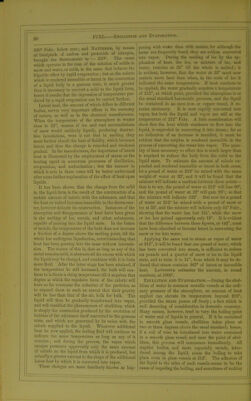
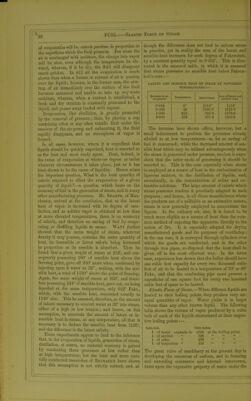
![DUEL Ebullition anu Evapobation. 1GG° Fahr. below zero; and Natteuer, by means of bisulphide of carbon and protoxide of nitrogen, j brought the thermometer to — 220°. Iho cause j which operates in the case of the solution of solids in j snow and water, or acids, is the same that induces the frigorilie effect by rapid evaporation; but as the caloric which is rendered insensible or latent in the conversion of a liquid body to a gaseous state, is much greater than is necessary to convert a solid to the liquid form, hence it results that the depression of temperature pro- duced by a rapid evaporation can he carried further. Latent heat, the amount of which differs in ditl'erent bodies, serves very important offices in the economy of nature, as well as in the chemical manufactures. When the temperature of the atmosphere in winter rises to 32°, masses of ice and vast accumulations of snow would suddenly liquefy, producing destruc- tive inundations, were it not that in melting they must further absorb the heat of fluidity, which becomes latent, and thus the change is retarded and rendered gradual. In the manufactures, the importance of latent heat is illustrated by the employment of steam as the heating agent in numerous processes of distillation, evaporation, and carbonization ; but the manner in which it acts in these cases will be better understood after some further explanation of the effect of heat upon liquids. It has been shown that the change from the solid to the liquid form is the result of the combination of a certain amount of caloric with the substance, and that the heat so united becomes insensible to the thermome- ter, however delicate its construction. Instances of the absorption and disappearance of heat have been given in the melting of ice, metals, and other substances, capable of passing into the liquid state. In the fusion of metals, the temperature of the bath does not increase a fraction of a degree above the melting point, till the whole has undergone liquefaction, notwithstanding that heat has been pouring into the mass without intermis- sion. The reason of this is, that as long as any of the metal remains solid, it abstracts all the excess with which the liquid may be charged, and combines with it to form more fluid. After the latter stage has been attained, if the temperature be still increased, the bath will con- tinue to indicate a rising temperature till it acquires that degree at which the repulsive force of the caloric will have so far overcome the cohesion of the particles, as to expand them to such an extent that their gravity will be less than that of the air, bulk for bulk. The liquid will then be gradually transformed into vapor, and will manifest the phenomenon of ebullition, which is simply the commotion produced by the evolution of bubbles of the substance itself converted to the gaseous state, and which are generated by its union with the caloric supplied to the liquid. Whatever additional heat be now applied, the boiling fluid will continue to indicate the same temperature as long as any of it remains ; and during the process, the vapor which escapes possesses apparently only the same amount of caloric ns the liquid from which it is produced, hut actually a greater amount in the shape of the additional latent heat by which it is converted into vapor. These changes are more familiarly known as hap- pening with water than with metals, for although the latter are frequently fused, they are seldom converted into vapor. During the melting of ice by the ap- plication of heat, the ice, or mixture of ice, and water, remains at 32° till the whole is melted; it is evident, however, that the water at 32° mast now contain more heat tlian when, in the state of ice it indicated the same temperature. If heat continue to be applied, the water gradually acquires a temperature of 212°, at which {joint, provided the atmosphere is at the usual standard barometric pro sure, and tire liquid be contained in an open iron or copper vessel, it re- mains stationary. It is now rapidly converted into vapor, but both the liquid and vapor are still at the temperature of 212° Fahr. A little consideration will show that the heat which continues to flow into the liquid, is expended in converting it into steam; for as no indication of an increase is manifest, it must be evident that the surplus is rendered insensible in the process of converting the water into vapor. Tine quan- tity of heat necessary to effect this is much larger than is required to reduce the body from the solid to the liquid state. To estimate the amount of caloric ex- pended and rendered insensible or latent in both cases, let a pound of water at 212° be mixed with the same weight of water at 32°, and it will be found that the mixture will indicate a medium between these points— that is to say, the pound of water at 212’ will lose 90’, and the pound of water at 32° will gain 90:; so that the mixture will indicate 122’. But now let a pound of water at 212’ be mixed with a pound of snow or ice at 32’, and the mixture will indicate only 51= Fahr.. showing that the water has lost 161°, while the snow or ice has gained apparently only 19°. It is evident that the difference between these figures, or 142°, must have been absorbed or become latent in converting the snow or ice into water. Applying the same test to steam or vapor of water at 212°, it will be found that one pound of water, which has been converted into steam, is sufficient to reduce six pounds and a quarter of snow or ice to the liquid state, and to raise it to 51°, from which it may be de- duced that steam contains 967° of latent or insensible heat. Lavoisier estimates the amount, in round numbers, at 1000°. Ebullition and Evaporation.—During the ebul- lition of water in common metallic vessels at the ordi- nary pressure of the atmosphere, no amount of heat applied can elevate its temperature beyond 212°, provided the steam passes off freely; a fact which is well deserving of consideration in domestic economy. Many causes, however, tend to vary the boiling point, of water and of liquids in general. If it be contained in smooth glass vessels, ebullition takes place at two or three degrees above the usual standard; hence, if a coil of wire be introduced into water contained in a smooth glass vessel, and near the point of ebul- lition, this process will commence immediate]}'. All angular bodies, and more especially metals, intro- duced among the liquid, cause the boiling to take place even in glass vessels at 212°. The adhesion of the liquid to the sides of such vessels seems to he the cause of impeding the boiling, and sometimes of making](https://iiif.wellcomecollection.org/image/b28121132_0002_0064.jp2/full/800%2C/0/default.jpg)