Volume 2
Chemistry, theoretical, practical, and analytical : as applied and relating to the arts and manufactures / by Dr. Sheridan Muspratt.
- James Sheridan Muspratt
- Date:
- [1860]
Licence: Public Domain Mark
Credit: Chemistry, theoretical, practical, and analytical : as applied and relating to the arts and manufactures / by Dr. Sheridan Muspratt. Source: Wellcome Collection.
76/644 page 32
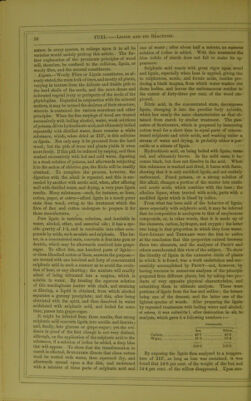
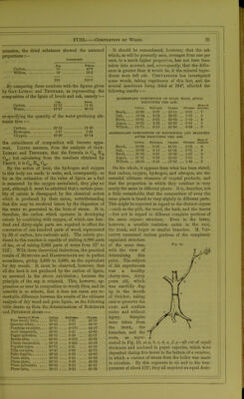
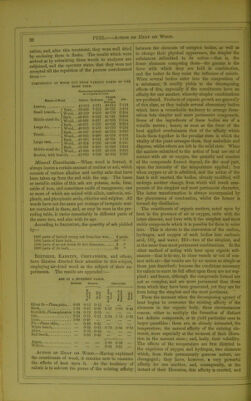
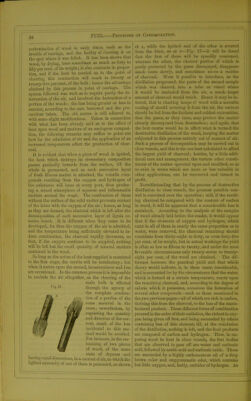
![FURL Action ok IIkat on Wood. cation, and, after this treatment, they were well dried by enclosing them in flasks. The results which were arrived at by submitting these woods to analyses are subjoined, and the operator states that they were not accepted till the repetition of the process corroborated them:— COMPOSITION' OP WOOD CUT FROM VAHIOUS FA UTS SAME THEE. Elementary substances found in KU pnrta of wood. Oxygen Carbon. Tlydrogen. and Nitrogen. 45-015 6-971 40-910 .52-496 7-312 36-737 .48-359 6-605 44-730 .48-855 6-342 41-121 .49-902 6-607 43-356 .46-871 5-570 44-656 .48-003 6-472 45-170 .46-267 5-930 44-755 .48-925 6-460 44-319 ,.49-085 6-024 48-761 .49-324 6-286 44-108 .50-367 6-089 41-920 .47-390 6-259 46-126 45-063 5-036 43-503 Nature of Wood. Leaves, Small branch,.. { ^od,! Middle-sized do. {wood,.' LarSe do {wood,'.' Trunk> {wood,! Large root, .... |Wo0(]) Middle-sized do. y/ood Rootlet, with branch, OP THE Afh. 7-118 3-454 0-304 3-682 0-134 2-903 0-354 2-657 0- 296 1- 129 0- 231 1- 613 0-223 5-007 Mineral Constituents.—When wood is burned, it always leaves a certain amount of residue or ash, which consists of various alkaline and earthy salts that have been taken up from the soil with the sap. The bases or metallic oxides of this ash are potassa, soda, lime, oxide of iron, and sometimes oxide of manganese; one or more of which are united with silicic, carbonic, sul- phuric, and phosphoric acids, chlorine and sulphur. All woods have not the same per centage of inorganic mat- ter contained in them, and, as may be seen in.the pre- ceding table, it varies remarkably in different parts of the same tree, and also with its age. According to Saussure, the quantity of ash yielded by- 1000 parts of barked young oak branches was— 4 parts, 1000 parts of their bark, 60 “ 1000 parts of an oak trunk 56 feet diameter, 2 “ 1000 parts of its bark, 60 “ Berthier, Karsten, Chevandier, and others, have likewise directed their attention to this subject, employing air-dried wood as the subject of their ex- periments. The results are appended:— ASII IN A HUNDRED PARTS. Berthier. Knrstcn. Chovnmlier. Silver fir—Pinuspicea,.. 0-83 Birch, 1-00 Scotch fir, Pinus sylvestris 1-24 Oak 2-50 Lime, 5-00 Fir—Pinus abics, — White beech, — Aider, — lied beech, — Aspen, Willow, _ In young wood In old wood. Solid stem wood. Wood of branches. Brush- wood 0-15 0-15 — 0-25 0-30 0-57 1-00 0-48 0-12 0-15 — 0-15 0-11 1-94 1-19 1-32 0-40 — , 0 23 0-25 — 0-32 0-35 0-73 1-54 0-72 0-35 0-40 — 0-38 0-40 — — — 1-49 2-38 . — — 2-94 3*GG — Action of Heat on Wood.—Having explained the constituents of wood, it remains now to examine the effects of heat upon it. As the tendency of caloric is to subvert the power of the existing affinity between the elements of complex bodies, as well as to change their physical appearance, the simpler the substances submitted to its action—that is, the fewer elements composing them—the greater is the force with which they are held in combination, and the better do they resist the influence of caloric. When several bodies enter into the composition of a substance, it readily yields to the decomposing effects of fire, especially if the constituents have an affinity for one another, whereby simpler combinations are produced. Products of organic growth are generally of this class, as they include several elementary todies which have a remarkable tendency to arrange them- selves into simpler and more permanent compounds. Some of the ingredients of these bodies are of a volatile nature; hence, as soon as the force of the heat applied overbalances that of the affinity which binds them together in the peculiar state in which the vitality of the plant arranges them, they assimilate and disperse, whilst others are left in the solid state. When the matters submitted to the action of heat are out of contact with air or oxygen, the quantity and number of the compounds formed depend, for the most part, upon the intensity of the temperature applied; but when oxygen or air is admitted, and the action of the heat is still exerted, the bodies, already modified, will undergo another change, from which will result com- pounds of the simplest and most permanent character. The latter transformation is always accompanied by the phenomena of combustion, whilst the former is termed dry distillation. The constituents of organic matters, acted upon by heat in the presence of air or oxygen, unite with the latter element, and form with it the simplest and most stable compounds which it is possible for them to enter into. This is shown in the conversion of the carbon, hydrogen, and oxygen of such bodies into carbonic acid, C02, and water, HO—two of the simplest, and at the same time most permanent combinations. In the other method of acting with heat upon organic sub- stances—that is to say, in close vessels or out of con- tact with air—the results are by no means so simple as those just described; because the conditions neeessary for caloric to exert its full effect upon them are not snp- plied ; and hence, although the compounds formed are not so complex, and are more permanent than those from which they have been generated, yet they are far from being the simplest and the most, persistent. From the moment when the decomposing agency of heat begins to overcome the existing affinity of the elements in the organic body, three circumstances concur, either to multiply the formation of distinct but definite compounds, or to yield particular ones in larger quantities : these are. as already intimated, the temperature; the natural affinity of the existing ele- ments, more especially at the moment of their libera- tion in the nascent state; and, lastly, their volatility. The effects of the temperature are first directed to the expulsion of oxygen and hydrogen, two elements which, from their permanently gaseous nature, are disengaged; they have, however, a very powerful affinity for one another, and, consequently, at the instant of their liberation, this affinity is exerted, and](https://iiif.wellcomecollection.org/image/b28121132_0002_0076.jp2/full/800%2C/0/default.jpg)
 No text description is available for this image
 No text description is available for this image
 No text description is available for this image