[Report of the Medical Officer of Health for London County Council 1898].
- London County Council (London, England). County of London.
- Date:
- [1899?]
Licence: Attribution-NonCommercial 4.0 International (CC BY-NC 4.0)
Credit: [Report of the Medical Officer of Health for London County Council 1898]. Source: Wellcome Collection.
33/274 (page 17)
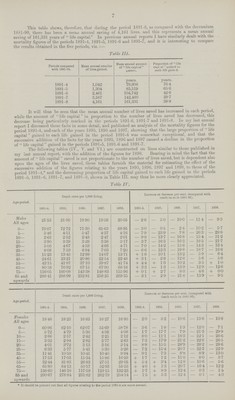
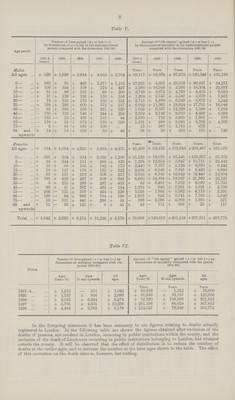
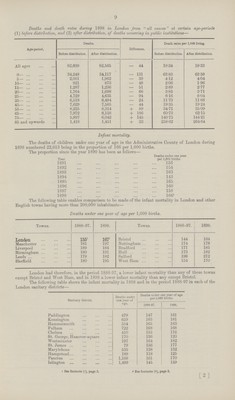
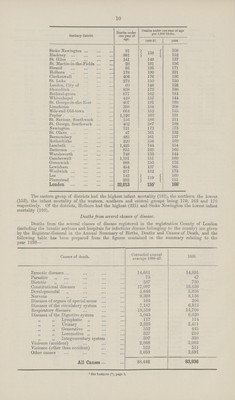
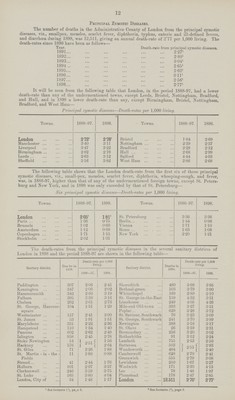
![17 The death-rates in each sanitary district of London in the period 1888-97 and in the year 1898 are shown in the following table— Sanitary district. Deaths in 1898. Death-rate per 1,000 living. Sanitary district. Deaths in 1898. Death-rate per 1,000 living. 1888-97. 1898. 1883-97. 1898. Paddington 93 .38 .73 Whitechapel 45 .72 .56 Kensington 120 .47 .70 St. George - in - the Bast 33 1.06 .69 Hammersmith 129 .49 1.20 Fulham 59 .79 .47 Limehouse 57 1.09 .97 Chelsea 92 .54 .95 Mile-end Old-town 93 .75 .83 St. George, Hanover square 35 .32 .44 Poplar 130 .76 .77 St. Saviour, South wark 17 .96 .69 Westminster 52 .56 .99 St. James 15 .55 .68 St. George, South wark 43 .96 .71 Marylebone 129 .57 .92 Hampstead 26 .27 .33 Newington 55 .77 .45 Pancras 111 .60 .46 St. Olave 5 .83 .44 Islington 334 .55 .97 Bermondsey 59 .82 .69 Stoke Newington 10 .48 .29 Rotherhithe 33 .67 .81 Hackney 111 1.51 Lambeth 135 .54 .45 St. Giles 26 .63 .69 Battersea 114 .54 .66 St. Martin - in - the Fields 1 .45 .08 Wandsworth 111 .55 Camber well 117 .60 .45 Strand 13 .71 .56 Greenwich 108 .57 .60 Holborn 85 .80 1.17 Lewisham 43 .28 .39 Clerkenwell 61 .96 .93 Woolwich 58 .63 1.40 St. Luke 37 1.08 .90 Lee 6 .27 .15 London, City of 8 .28 .28 Plumstead 58 .54 .93 Shoreditch 108 .85 .89 London 3,077 .611 .681 Bethnal-green 152 .93 1.18 The prevalence of measles among school children is referred to in the reports relating to the following districts— Paddington—The infants' department of the Board Schools in Campbell-street was closed on account of prevalence of measles by order of the vestry from the 15th March to the 29th March, of the St. Paul's Church Schools from the 29th March to the 18th April, and of the St. Mary's Church School from the 31st March to the 18th April. The attendances in the infants' department of some of the other schools were very greatly reduced, but closure was not found necessary. The code drawn up by the School Board for London for use in the Board's schools directs the teachers to report to the medical officer of health of the district in which the scholar resides every case of measles coming to their knowledge. It was found that this provision was not understood by the teachers, but when pointed out to them, was very generally acted upon. Westminster—Measles was very prevalent at the beginning of the year in St. John's Infant School, Tufton-street. On January 10th, when school was re-opened, out of a possible 233 scholars only 123 were present, 25 of the absent being known to be suffering from measles. St. Pancras—The infants' departments of the Home and Colonial Practising School in Gray's-inn-road, and of the National Schools in Camden-street were closed in June on account of the prevalence of measles in the neighbourhood and in the schools. Islington—In a detailed report on the progress of the disease in Islington, the medical officer of health refers to its prevalence among the children attending the infants' departments of St. Anne's Church School and of Upper Hornsey-road and Poole's-park Board Schools which were closed for this reason in the latter part of 1897. The disease subsequently spread to other parts of the district, and the infants' departments in the following schools were closed: the Foster-road Board School, closed at the end of January; the St. Mark's Church School, Grove-road, the Yerbury-road Board School, the St. Paul's Church Schools, the Station-road Board School, the Caledonian-road Board School, the St. Mary Magdalen (Chapel of Ease) Church School, closed in February; the St. Mary Church Schools, the St. Clement Schools, the Ecclesbourne-road Board Schools, the West bourne-road Board Schools, the Canonbury-road Board School, and the Duncombe-road Board School were closed in March. After the Easter holiday, in April, the infants' department of the Victoria-place Board Schools were closed. An interesting table in the report shows that 7,193 children were on the rolls of the infants' departments of these several schools, that 2,035 of these children were attacked with measles or were living in infected houses, or 28 3 per cent. The longest period for which the sanitary authority ordered the schools to be closed was 28 days, the usual period being 21 days. the medical officer of health adds that he is of opinion that it would have been better if the schools had been closed when the proportion of absentees on account of measles had reached 10 9er cent., and he writes Unfortunately in most cases I was unable to carry out my desires, because I had not daily information from the head teachers of the infant schools ; indeed, it was only when there was an unusual number of children absent, or when I made enquiries, that they suddenly awoke to the necessity of notifying the absentees to me. I think they more thoroughly understand the im portance of this matter now, and that the future will show that cases of measles will be more readily notified by them than has been their custom. In nearly every instance inquiries were 1 See footnote (1) page 3. [3]](https://iiif.wellcomecollection.org/image/b18252473_0033.jp2/full/800%2C/0/default.jpg)