Principles of physiological psychology / translated from the Fifth edition by E.B. Tichener.
- Wilhelm Wundt
- Date:
- 1904
Licence: In copyright
Credit: Principles of physiological psychology / translated from the Fifth edition by E.B. Tichener. Source: Wellcome Collection.
Provider: This material has been provided by The University of Leeds Library. The original may be consulted at The University of Leeds Library.
341/376 (page 319)
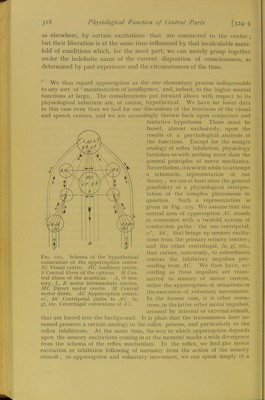
![325-6] Psychophysical Analysis : Apperception Centre 3>9 regulative influence of the excitations in progress,—the implication being that a large number of intermediate terms, which our methods cannot reach, exert a determining influence upon the final result. The physiological character of these intermediaries is wholly unknown to us. We can only infer, from psycho- 1 >gical experience, that definite dispositions take shape in every brain, as the consequence of generic and individual development, and determine the excitatory processes that run parallel with the act of apperception. If, then, we refer the apperceptive acts to a particular physiological substrate, we can do so only on the condition that we endow the central area in question with con- nexions to the other central parts, in virtue of which the excitations released in it are dependent upon these dispositions. Hence the centrifugal paths that issue from the apperception organ AC and serve to conduct the inhibitory excitations must, in general, take two directions : a centrifugal sensory and a centrifugal motor. In both directions they are connected, both directly and indirectly, by way of intermediate centres that represent nodal points of con- duction for certain complex functions, with the direct sensory centres (SC, HC] and the motor centres (il/C). The part of intermediary is played, within the centrifugal sensory path, by certain intermediate sensory centres (O and A) ; within the motor path, by analogous motor centres of complex character (B and L). The term ' centre ' is here used, of course, only in the relative sense defined above, in the discussion of the visual and speech centres. We found, e.g., that the speech centres were not to be regarded as independent sources of the iunctions ordinarily ascribed to them, but simply as indispensable inter- mediaries in the mechanism of speech associations and apperceptions ; and the same conclusion holds here. The physiological significance of these centres may be roughly illustrated in this way. We will suppose that various sensa- tions, belonging to the domain of speech, have arisen in the sense centres proper, SC and HC. The corresponding excitations are at once combined, in the intermediate sensory centres 0 and A, into an unitary excitation process ; whereupon the apperceptive inhibition can operate to render this, or the primary excitations in progress in the centres SC and HC, clearer or more obscure. The processes in O and A will thus have the significance of resultants, which corre- spond to the functional unification of the two associatively connected elements, phonetic utterance and script form. These resultants must not, we need hardly repeat, be regarded as traces, stamped indelibly upon certain cells, but ratherv as transitory processes of extremely complex character, embracing a large variety of elements,—processes akin to the stimulation processes in the peripheral sense organs, and to other processes in the central nerve substance, all of which leave a disposition to their renewal behind them. A like function must be assigned to the intermediate motor centres B and L, in which an act of apperception releases 'by the paths gfrs, y$p<r) a determinate motor excitation, corre- sponding to the sensory excitations brought up from SC and HC (by ss', hh'), or from O and A (by ek, c/c) ; or else an unmediated activity on the part of the two elements, phonetic utterance and script form, releases (by the paths e f, tff>/ the corresponding motor impulses, without interference from the apperception centre, i.e. by way of a direct reflex excitation. These impulses are then, in all cases, carried (by the paths f r s, <f>p<r) to the general motor centres MC, whence they are transmitted along the further nerve conduction to the muscles. In the hypothetical schema of Fig. 105, the paths that lead towards AC and all paths of connexion between subordinate centres are represented by](https://iiif.wellcomecollection.org/image/b21504520_0341.jp2/full/800%2C/0/default.jpg)