Further illustrations of the practical operation of the Scotch system of management of the poor / by W.P. Alison, M.D., &c., Professor of the Institutes of Medicine in the University of Edinburgh.
- William Pulteney Alison
- Date:
- [1841]
Licence: Public Domain Mark
Credit: Further illustrations of the practical operation of the Scotch system of management of the poor / by W.P. Alison, M.D., &c., Professor of the Institutes of Medicine in the University of Edinburgh. Source: Wellcome Collection.
Provider: This material has been provided by The University of Glasgow Library. The original may be consulted at The University of Glasgow Library.
24/34 page 24
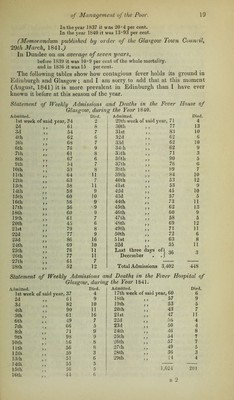
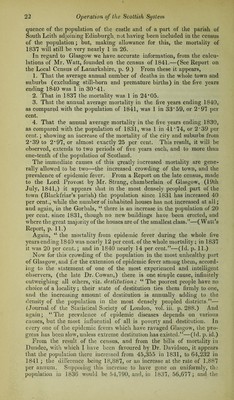
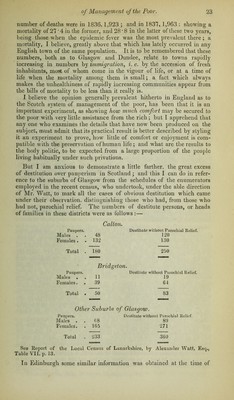
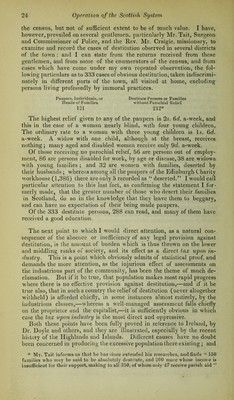
![the census, but not of sufficient extent to be of much value. I have, however, prevailed on several gentlemen, particularly Mr. Tait, Surgeon and Commissioner of Police, and the Rev. Mr. Craigie, missionary, to examine and record the cases of destitution observed in several districts of the town ; and I can state from the returns received from these gentlemen, and from some of the enumerators of the census, and from cases which have come under my own repeated observation, the fol- lowing particulars as to 333 cases of obvious destitution, taken indiscrimi- nately in different parts of the town, all visited at home, excluding persons living professedly by immoral practices. Paupers, Individuals, or Destitute Persons or Families Heads o? Families. w ithout Parochial Relief. 121 212- The highest relief given to any of the paupers is 2.9. Qd. a-week, and this in the case of a woman nearly blind, with four young children, The ordinary rate to a woman with three young children is 1.9. 6c/. a-week. A widow with one child, although at the breast, receives nothing; many aged and disabled women receive only 9d. a-week. Of those receiving no parochial relief, 56 are persons out of employ- ment, 86 are persons disabled for work, by age or disease, 38 are widows with young families ; and 32 are women with families, deserted by their husbands; whereas among all the paupers of the Edinburgh Charity workhouse (1,386) there are only 5 recorded as “ deserted.” I would call particular attention to this last fact, as confirming the statement I for- merly made, that the greater number of those who desert their families in Scotland, do so in the knowledge that they leave them to beggary, and can have no expectation of their being made paupers. Of the 333 destitute persons, 288 can read, and many of them have received a good education. The next point to which I would direct attention, as a natural con- sequence of the absence or inefficiency of any legal provision against destitution, is the amount of burden which is thus thrown on the lower and middling ranks of society, and its effect as a direct tax upon in- dustry. This is a point which obviously admits of statistical proof, and demands the more attention, as the injurious effect of assessments on the industrious part of the community, has been the theme of much de- clamation. But if it be true, that population makes most rapid progress where there is no effective provision against destitution,—and if it be true also, that in such a country the relief of destitution (never altogether withheld) is afforded chiefly, in some instances almost entirely, by the industrious classes,—whereas a w^ell-managed assessment falls chiefly on the pro])rietor and the capitalist,—it is sufficiently obvious in which case the tax upon industry is the most direct and oppressive. Both these points have been fully proved in reference to Ireland, by Dr. Doyle and others, and they are illustrated, especially by the recent history of tlie Highlands and Islands. Different causes have no doubt been concerned in producing the excessive population there existing; and * Mr. Tait informs us that he has since extended his researches, and finds “ 150 families who may be said to be absolutely destitute, and 200 more whose income is insufficient for their support, making in all 350, of whom oidy 47 receive parish aid ”](https://iiif.wellcomecollection.org/image/b24929761_0026.jp2/full/800%2C/0/default.jpg)