Further illustrations of the practical operation of the Scotch system of management of the poor / by W.P. Alison, M.D., &c., Professor of the Institutes of Medicine in the University of Edinburgh.
- William Pulteney Alison
- Date:
- [1841]
Licence: Public Domain Mark
Credit: Further illustrations of the practical operation of the Scotch system of management of the poor / by W.P. Alison, M.D., &c., Professor of the Institutes of Medicine in the University of Edinburgh. Source: Wellcome Collection.
Provider: This material has been provided by The University of Glasgow Library. The original may be consulted at The University of Glasgow Library.
9/34 page 9
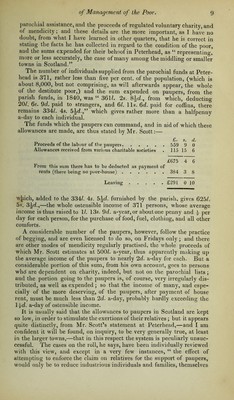
![])arocliial assistance, and the proceeds of regulated voluntary charity, and of mendicity; and these details are the more important, as I have no doubt, from what I have learned in other quarters, that he is correct in stating the facts he has collected in regard to the condition of the poor, and the sums expended for their behoof in Peterhead, as “ representing, more or less accurately, the case of many among the middling or smaller towns in Scotland,” The number of individuals supplied from the parochial funds at Peter- head is 371, rather less than five per cent, of the population, (which is about 8,000, but not comprising, as will afterwards appear, the whole of the destitute poor,) and the sum expended on paupers, from the l)arish funds, in 1840, was “ 36U. 2s. 8jc/., from which, deducting 20/. 6s. 9d. paid to strangers, and 6/. 11s. M. paid for coffins, there remains 334/. 4s. 5jc/.,” which gives rather more than a halfpenny a-day to each individual. The funds which the paupers can command, and in aid of which these allowances are made, are thus stated by Mr. Scott:— £. s. d. Proceeds of the labour of the paupers 559 9 0 Allowances received from various charitable societies . 115 15 6 £675 4 6 From this sum there has to be deducted as payment of rents (there being no poor-house) 384 3 8 Leaving £291 0 10 w[iich, added to the 334/. 4s. 5^c/. furnished by the parish, gives 625/. 5s. 3jc/.,—the whole ostensible income of 371 persons, whose average income is thus raised to 1/. 13s. 9c/. a-year, or about one penny and ^ per day for each person, for the purchase of food, fuel, clothing, and all other comforts. A considerable number of the paupers, however, follow the practice of begging, and are even licensed to do so, on Fridays only; and there are other modes of mendicity regularly practised, the whole proceeds of which Mr. Scott estimates at 500/. a-year, thus apparently making up the average income of the paupers to nearly 2c/. a-day for each. But a considerable portion of this sum, from his own account, goes to persons wh(5 are dependent on charity, indeed, but not on the parochial lists; and the portion going to the paupers is, of course, very irregularly dis- tributed, as well as expended; so that the income of many, and espe- cially of the more deserving, of the paupers, after payment of house rent, must be much less than 2c/. a-day, probably hardly exceeding the l^c/. a-day of ostensible income. It is usually said that the allowances to paupers in Scotland are kept so low, in order to stimulate the exertions of their relatives; but it appears quite distinctly, from Mr. Scott’s statement at Peterhead,—and I am confident it will be found, on inquiry, to be very generally true, at least in the larger towns,—that in this respect the system is peculiarly unsuc- cessful. The cases on the roll, he says, have been individually reviewed with this view, and except in a very few instances, “ the effect of attempting to enforce the claim on relatives for the support of paupers, would only be to reduce industrious individuals and families, themselves](https://iiif.wellcomecollection.org/image/b24929761_0011.jp2/full/800%2C/0/default.jpg)