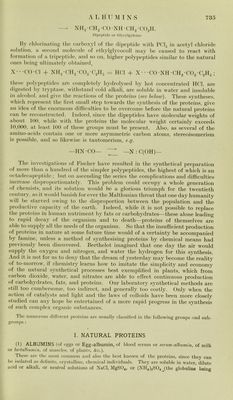
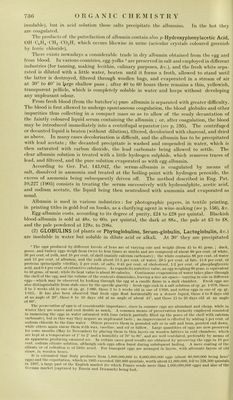
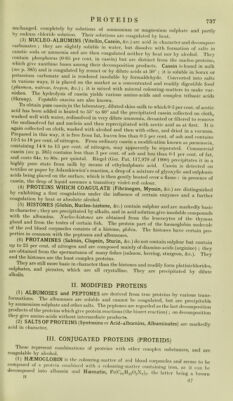
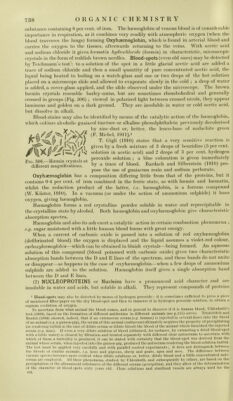
Treatise on general and industrial organic chemistry / Tr. from the 2d enl. and revised Italian edition by Thomas H. Pope.
- Ettore Molinari
- Date:
- 1913
Licence: In copyright
Credit: Treatise on general and industrial organic chemistry / Tr. from the 2d enl. and revised Italian edition by Thomas H. Pope. Source: Wellcome Collection.
761/798 page 739
![with a Nucleic Acid, which is phosphoric acid neutralised partially by basic orgaiiic groups, sudi as xanthine, guanine, &c. The nucleins contain 5-7 per cent. P, 41 per cent. C, and 31 per cent, O, and are hence sharply distinguished troni trae proteina although they give thè sanie coloni- reactions. They forni thè fundamental constituents of celi nuclei. (3) GLUCOPROTEINS are acid in character and are formed of a protein combined a sugar derivative. They are insoluble in water and with a little lime-water give neutral frothy, and ropy Solutions which are not coagulated by heat or by nitric acid. \\ hen hydrolysed with al bali or acid they yield sugar, peptones, and Syntonins. These compound», which are poor in nitrogen (11-7 to 12-3 per cent.), include thè Mucins. IV. ALBUMINOIDS These constitute thè fundamental parts of thè cartilaginous tissues and epidermis of ani mais and comprise : (] ) ELASTIN, which forms thè elastic part of thè tendons and ligaments, is insoluble in dilute acid or alkali, but with thè latter loses thè wliole of its sulphur. (2) KERATIN is thè principal constituent of thè nails, horns, feathers, epidermis, am, &c. It is insoluble in water, but wlien lieated under pressure, best in presence of alkali, it dissolves with partial decomposition. It contains 4-5 per cent, of sulphur, which is ehminated to some extent by boiling water. With nitric acid it gives thè yellow xanthoprotein reaction (see above, Blood-spots on skin treated with nitric acid). (3) The COLLAGENS are abundant in bones, liair, tendons, and cartilage. They combine with water at thè boiling-point and dissolve, forming ordinary glue or gelatine, which is precipitated by tannili or by mercurio chloride acidified with HC1 but not by minerai acids. They contain stably combined sulphur. They consist, to thè extent of So per cent., of amino-acids (Skraup, Biehler and Bottcher, 1909-1910), and, like thè protamines, are trae proteins containing methoxy- and azomethyl-groups. Unlike casein, t ìey give httle glutamic acid on hydrolysis. On hydrolysing them with caustic baryta, B. r ischer and R. Boehner (1910) obtained Proline (a-pijrrolidinecarboxylic acid) as primary product ; «-Amino-c-hydroxyvaleric Acid, which is obtained from gelatine, does not give proime with baryta. By digesting gelatine with trypsin, Levene (1910) obtained mainly Prolylglycocoll Anhydride. The absorptive power of thè collagens for carbon disulphide, which in presence of alkali leads to thiohydration, allows of their differentiation from agglutinatmg substances (Sadikow, 1910); thè agglutination of gelatine is not only a ìsgregation of thè collagen molecule, but also a condensation of thè side-chains. Gelatine which has undergone prolonged exposure to light loses’some of its absorptive power for water owing to thè formation of formaldehyde, which hardens thè glue (Meisling 1909) On hydrolytic decomposition, thè collagens give glycocoll (while thè albumins give tyrosine)’ eucine, glutamic acid, and asparagine.1 Very dilute Solutions of glue give, with boiling ammonii!m molybdate Solutions, a characteristic precipitate and colourecl solution, which may be apphed to quantitative estimations (E. Schmidt, 1910). . Manuf^ctur® of Glu® and Gelatine. The prime materials are bones and bidè waste, generally untanned hnlP tTr'hd r^Vime- Flì0m b°nes the fat is first extracted (*«« P- 392 and also voi. i, p. 508), and thè crushed bones then heated for a couple of bours in a large autoclave with water and steam under pressure, so as to convert usedTr a ™h° “? 5 thTÌS treatment is rePeated or three times, the final more dilute Solutions beTng used for a subsequent operation. In some cases, however, the bones and hence also thè glue are freed from caldura phosphate by treatment with four times their weight of 6 to 7 per cent, hydrochloric acid (sp. gr. 1-05) until complete whnTl'h8 °CCUrS ; V16 calcium Phosphate is precipitated from the solution by means of lime and caldura carbonate bile thè ossein, plaeed in a double-bottomed vessel heated by steam, is rapidly converted into a solution of glue’ thè GCir' Pat' 144,398! tbe calciura Phosphate may be dissolved by aqueous SO., under pressure (only thè treatment under Pressure is patcnted). The solution obtained by either of these methods, with a concentration of 17 to 18 on thè glue-densimeter in summer and 12° to 14° in winter, can be partly decolorised while stili hot bjJa cflurr.ent of salPhur dioxide ; it is then mtroduced into zinc moulds surrounded by coki water to solidify. The solidiflcation of these Solutions (and even more dilute ones) is now hastened by refrigeration. The solid blocks of glue are then cut into suitable sizes and dried on wide-meshed nets arranged on trolleys, which are plaeed in chambers through which air at 25° to 30° is circulated by means of fans. If the air is abóve this temperatre thè glue will melt, while if it is too dry the cakes are deformed. On this account and also because it wouTd readdv perqdntfr “ SUmmer’ ^ bone~«lue contains 15 to 20 P^ cent, of water and costs 52* to68, Skin-glue (leatlier glue) is prepared from hide-waste and also other waste (nerves, cartilage, &c ) by defattin- with carbon disulphide and softemng or swelling in water, which likewise removes impurities. It is then macera ed ,Z ÌZX'f? m,f “T ,rse S f?nU,“l*mi,k » frequenti, renewed to eliminato àny ““ fat blo°d, de. It is then thoroughly washed in water and the last tracea of lime (which would make the è uè turbid) removed by meana of dilato hydrochloric acid, or, better, of nulphur dioyide or phosphoric acid The](https://iiif.wellcomecollection.org/image/b28056309_0761.jp2/full/800%2C/0/default.jpg)