Syntheses in the epinephrine series / by Frank Tutin, Frederic W. Caton and Archie C.O. Hann.
- Tutin, Frank.
- Date:
- [1909?]
Licence: In copyright
Credit: Syntheses in the epinephrine series / by Frank Tutin, Frederic W. Caton and Archie C.O. Hann. Source: Wellcome Collection.
12/18 page 2122
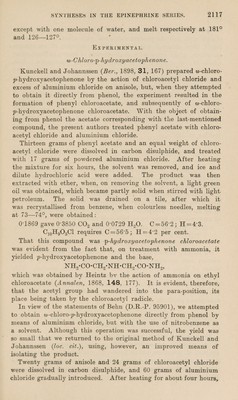
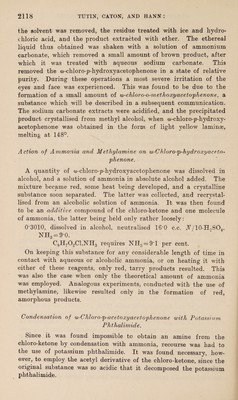
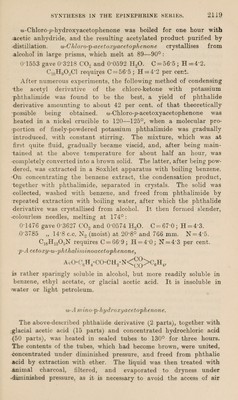
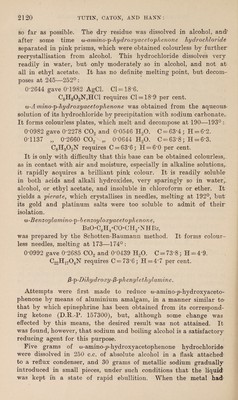
![dibenzoyl compound, melting at 210°, it would appear that the latter possesses the structure BzO*C6H4*CH(OH)*CH2*NHBz: <0-1017 gave 0'2736 C02 and 0*0486 H20. C = 73'4; H = 5-3. <0-1070 „ 0-2860 002 „ 0'0500 H20. C = 72*9; H = 52. C22H1904N requires C = 73l; H=5*3 per cent. The results of the physiological experiments, recorded in the introductory portion of this paper, also afford confirmation of the fact that j8-p-dihydroxy-/3-phenylethylamine had been formed by the reduction of the w-amino-p-hydroxyacetophenone, although the former compound could not be isolated in a state of purity. As previously stated, attempts were made to prepare some of the above-described compounds by other means. Although the desired results were not thus attained, these experiments led to the production of a variety of new compounds, which are described below. p-Hydroxyacetophenone was reduced by means of sodium amalgam, both in alkaline and acid solutions, and also by aluminium amalgam. The greater part of the product was, in each case, a viscid oil, but a crystalline solid was also formed, the amount of the latter being greatest when the neutral reducing agent was employed. Twenty grams of p-hydroxyacetophenone were dissolved in a large volume of aqueous methyl alcohol, and a quantity of aluminium amalgam added. The mixture was kept, with occasional stirring, until the aluminium had disappeared, when the product was extracted with ether. The material obtained after removing the solvent was dissolved in ethyl acetate, when 7'5 grams of a solid, in the form of a crystalline powder, gradually separated. This product was crystallised from alcohol, when it formed small, colourless prisms, which melted at 207—208°. It was sparingly soluble in alcohol and in water, and nearly insoluble in ethyl .acetate. 0-1523 gave 0’3908 C02 and 0*0914 H20. C = 69-6; H = 6*7. C8H10O2 requires C = 69*6; H = 7*2 per cent. C16H]804 „ C = 70-l; H = 6'6 This substance proved to be the pinacone, C16H1804, and not the desired secondary alcohol, as shown by the molecular weight of its tetra-acetyl derivative. The latter compound, formed in the usual way, crystallised from alcohol in colourless leaflets, which melted .at 188—189°: 0-1293 gave 0*3086 C02 and 0-0710 H20. C = 65T; H = 6T. C24H2608 requires C —65*2; H=5*9 per cent.](https://iiif.wellcomecollection.org/image/b3061420x_0012.jp2/full/800%2C/0/default.jpg)
 No text description is available for this image
 No text description is available for this image
 No text description is available for this image