The interstitial or cementing substances in the Elgin sandstones.
- Mackie, William
- Date:
- [1901]
Licence: In copyright
Credit: The interstitial or cementing substances in the Elgin sandstones. Source: Wellcome Collection.
Provider: This material has been provided by The Royal College of Surgeons of England. The original may be consulted at The Royal College of Surgeons of England.
6/75 page 28
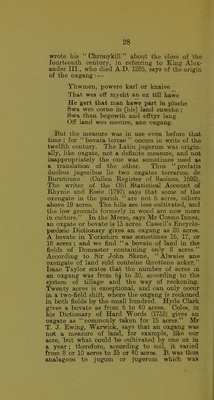
![wrote his “ Chronykill ” about the close of the fourteenth century, in referring to King Alex- ander III., who died A.D. 1285, says of the origin of the oxgang : — Yhwmen, powere karl or knaive That wes off mycht an ox till hawe He gert that man hawe part in pluche Swa wes corne in [his] land enwehe; Swa than begowth and efftyr lang Off land wes mesure, ane oxgang. But the measure was in use even before that time ; for “ bovata terra© ” occurs in writs of the twelfth century. The Latin jugerum was origin- ally, like oxgate, not a definite measure, and not inappropriately the one was sometimes used as a translation of the other. Thus “ prefatis duobus jugeribus lie two oxgates terrarum de Bumtoune (Cullen Register of Sasines, 1692). The writer of the Old Statistical Aocount of Rhynie and Essie (1797) says that some of the oxengate in the parish “ are not 6 acres, others above 19 acres. The hills are less cultivated, and the low grounds formerly in wood are now more in culture.” Ini the Merse, says Mr Cosmo Lines, an oxgate or bovate is 13 acres. Cassell’s Encyclo- paedasic Dictionary gives an oxgang as 20 acres. A bovate in Yorkshire was sometimes 16, 17, or 18 acres ; and we find “ a bovate of land in the fields of Doncaster containing only 8 acres.” According to Sir John Skene, “ Alwaies ane oxengate of land suld eonteine threttene acker.” Isaac Taylor states that the number of acres in an oxgang was from 6£ to 30, according to the system of tillage and the way of reckoning. Twenty acres is exceptional, and can only occur in a two-field shift, where the oxgang is reckoned in both fields by the small hundred. Hyde Clark gives a bovate as from 6 to 40 acres. Coles, in his Dictionary of Hard Words (1732) gives an oxgate as “ commonly taken for 15 acres.” Mr T. J. Ewing, Warwick, says that an oxgang was not a measure of land, for example, like our acre, but what could be cultivated by one ox in a year; therefore, according to soil, it varied from 8 or 10 acres to 35 or 40 acres. It was thus analagous to jugum or jugerum which was](https://iiif.wellcomecollection.org/image/b22427685_0006.jp2/full/800%2C/0/default.jpg)