Lectures on Bright's disease : delivered at the Royal Infirmary of Glasgow / by D. Campbell Black.
- Black, Donald Campbell, 1841-1898.
- Date:
- 1875
Licence: Public Domain Mark
Credit: Lectures on Bright's disease : delivered at the Royal Infirmary of Glasgow / by D. Campbell Black. Source: Wellcome Collection.
Provider: This material has been provided by the Francis A. Countway Library of Medicine, through the Medical Heritage Library. The original may be consulted at the Francis A. Countway Library of Medicine, Harvard Medical School.
69/156 page 65
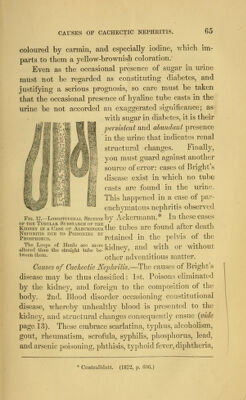
![CAUSES OF CACHECTIC NEPHRITIS. coloured by carmin, and especially iodine, which im- parts to them a yellow-brownish coloration. Even as the occasional presence of sugar in urine must not be regarded as constituting diabetes, and justifying a serious prognosis, so care must be taken that the occasional presence of hyaline tube casts in the urine be not accorded an exaggerated significance; as with sugar in diabetes, it is their persistent and abundant presence in the urine that indicates renal structural changes. Finally, you must guard against another source of error: cases of Bright's disease exist in which no tube casts are found in the urine. This happened in a case of par- enchymatous nephritis observed Fig. 17.-Longitudinal Section by Ackermann.* Ill these Cases of the Tubular Substance of the , 1 . n r ~\ £■+„■„ J«„+L Kidney in a Case of Albuminous the tubes are found alter CLeatn Nephritis due to Poisoning by . . t . ,-t i • „n +t_ . Phosphorus. retained m the pelvis ot tne The Loops of Henle are more -y'rlinOT7 0-^] wifL OT» without altered than the straight tube be-KlClliey? anCl WltU 0i WiLiiUUL tween them. ot}ier adventitious matter. Causes of Cachectic Nephritis.—The causes of Bright's disease may be thus classified: 1st. Poisons eliminated by the kidney, and foreign to the composition of the body. 2nd. Blood disorder occasioning constitutional disease, whereby unhealthy blood is presented to the kidney, and structural changes consequently ensue (vide page 13). These embrace scarlatina, typhus, alcoholism, gout, rheumatism, scrofula, syphilis, phosphorus, lead, and arsenic poisoning, phthisis, typhoid fever, diphtheria, Ccntralblatt. (1872, p. 606.)](https://iiif.wellcomecollection.org/image/b2104241x_0069.jp2/full/800%2C/0/default.jpg)