Lectures on Bright's disease : delivered at the Royal Infirmary of Glasgow / by D. Campbell Black.
- Black, Donald Campbell, 1841-1898.
- Date:
- 1875
Licence: Public Domain Mark
Credit: Lectures on Bright's disease : delivered at the Royal Infirmary of Glasgow / by D. Campbell Black. Source: Wellcome Collection.
Provider: This material has been provided by the Francis A. Countway Library of Medicine, through the Medical Heritage Library. The original may be consulted at the Francis A. Countway Library of Medicine, Harvard Medical School.
80/156 page 76
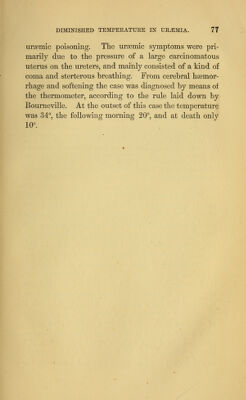
![diminished by an exclusively amylaceous diet, and why the urine of the carnivora is so much richer in this material than that of the herbivora. It would further explain the views* put forth by Mr. Simon, that fibrine is one of the constituents that have arisen from the waste of tissue; hence the amount of fibrine in the blood is greater in acute nephritis—the eremacausis being more active than in the chronic; and it would harmonise with Lehmann's allegation that it is an error to suppose that arterial blood is usually richer in fibrine than venous, the contrary being the case, as the smaller veins contain a notably larger quantity of fibrine than the corresponding arteries. But, again, should there exist desquamation of the secretory cells of the convoluted tubes, urea will not be eliminated except to a small extent vicariously, and its accumulation in the blood will prevent the transforma- tion of fibrine, and the latter may thus increase in the blood from a totally different cause. In this case there is accounted for the decreased temperature in cases of uraemia. So constant is the decrease of temperature in uraemia that the thermometer has been used as an aid to diagnosis. It thus enables us to distinguish between hysteria, epilepsy, and uramiia. In the two former there is an increase of temperature; in the latter a marked diminution. Not long ago M. Hanot presented to the Societe de Biologie a report of an interesting case of death from * After the writing of the above, Mr. Alfred IT. Smee, (Proced. Eoy. Soc, June 16th, 1874), pointed out that when a current of oxygen gas is passed throu0]! ordinary albumen, or albumen from the fluid of spina bifida, at the temperature of the human body (98 Fah.), a certain amount of the albumen is transferred into fibrine. The albumen found in the urine is not capable of this transformation.](https://iiif.wellcomecollection.org/image/b2104241x_0080.jp2/full/800%2C/0/default.jpg)