Some account of the origin and objects of the new Oxford examinations for the title of Associate in Arts and certificates, for the year 1858 / by T.D. Acland ; also letters from J. Hullah [and others] and selected papers relating to the West of England examination.
- Acland, Sir Thomas Dyke, 1809-1898.
- Date:
- 1858
Licence: Public Domain Mark
Credit: Some account of the origin and objects of the new Oxford examinations for the title of Associate in Arts and certificates, for the year 1858 / by T.D. Acland ; also letters from J. Hullah [and others] and selected papers relating to the West of England examination. Source: Wellcome Collection.
Provider: This material has been provided by The Royal College of Surgeons of England. The original may be consulted at The Royal College of Surgeons of England.
237/256 (page 209)
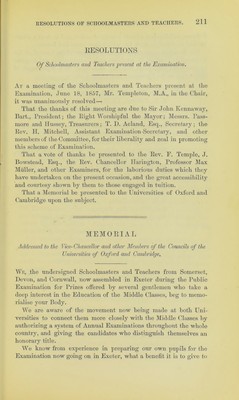
![j\IR. tempi.eton’s speech. 200 all of thorn did their work, not by teaching only, but by writing. Let \is hope, therefore, that Oxford, by being brought again into closer contact with the requirements of the country at large, will contribute its share towards the successful working of the scheme which has been inauguiated to-day at Exeter. If this is the case, the measure which was passed to-day at Oxford will, like every liberal measure, confer benefits, not only on the receiver, but on the giver also. (Hear, hear.) And I believe that for many years, nay, for many centuries, to come, this county of Devon, and this city of Exeter, will have reason to be proud that this scheme of Middle- Class Education has been originated, and has hitherto been so suc- cessfully carried out chiefly by Devonshire men, such as Mr. Acland, ]\Ir. Temple, and those who think, and feel, and work with them. Mr. Tkmplkton, of Mansion House School, Exeter, presented himself, and said it became his duty, on behalf of the schoolmasters of Somerset, Devon, and Cornwall, who had taken a p^irt in this examination, to present their thanks to the committee and the exa- miners, for the satisfactory manner in which the examinations had been conducted. If a learned professor, who had the command of all the languages in the world, felt a difficulty in addressing such an audience, how must he feel after hearing the lieai’t-stirring speech from Mr. Temjde, the excellent address from the Chancellor Haring- ton, and the practical remarks of Mr. Bowstead? The schoolmasters and teachers of Somerset, Devon, and Cornwall, had met and con- sidered it their duty to address the committee on this occasion, and to add a few words of thanks to that committee and also to the exa- miners, as well as to memorialise the two tFniversities. Like the ‘prophet cloud which first appeared about the size of a man’s hand, this movement now going on relative to middle-class education was overspreading the land. They had commenced a middle-class edu- cation examination in the AVest of England; this was a great event, and it showed how much they owed to the gentlemen who had pro- moted the scheme for the last six months. His fellow-schoolmasters around him were like the men in the late war, for they were volun- teers, not being compelled to come in. But every schoolmaster should come forward. The prizes were offered to their pupils, and for the credit of their pupils they must come forward. The move- ment was originated by gentlemen he saw around him, and these had procured the aid of Her Majesty’s Inspector; and he hoped these gentlemen would find that the schoolmasters were desirous to pro- mote education, and that they did try to do their duty. He hoped](https://iiif.wellcomecollection.org/image/b22440392_0239.jp2/full/800%2C/0/default.jpg)