The planning of fever hospitals and disinfecting and cleansing stations.
- Freeman, Albert C.
- Date:
- [1909]
Licence: In copyright
Credit: The planning of fever hospitals and disinfecting and cleansing stations. Source: Wellcome Collection.
Provider: This material has been provided by London School of Hygiene & Tropical Medicine Library & Archives Service. The original may be consulted at London School of Hygiene & Tropical Medicine Library & Archives Service.
168/202 page 148
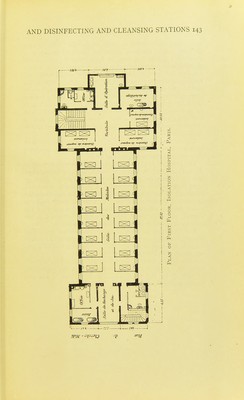
![each about lo ft. by 8 ft., ami 12 ft. high. The division between each of the small wards and the main ]mssage is of glass down to 2 ft. 6 in. from the floor. Either acute cases of diphtheria are accommodated in these sectional wards, or they are used for cases complicated by measles, scarlet fever, etc. Each child is perfectly isolated, yet does not feel lonely, as the children are visible to one another. The nurse can also easily supervise them. An additional advantage is that a restless child does not disturb the other patients nearly so much as in an open ward. Each of these rooms has a bed, a table, chair and other utensils, all of metal. A movable electric lamp is provided, and there is also a tap of water and a small sink in each chamber. The measles wards are similar, save that on the first floor each bed is not placed m an isolated chamber, but is separated only by fixed screens of glass and metal. The principle of glass partitions rather commends itself to us, and appears to be worthy of consideration for future hospi- tals for children, probably with some modification. Here, no child is allowed out of the hospital, or permitted to return to a public school, until bacteriological examination has shown the absence of Leofflier's bacillus. An examination is made in every case on admission and throughout the course of the disease, and antitoxin is regularly used. Incubation is fre- quently practised in cases demanding interference. The diphtheria pavilion contains thirty-seven beds, that for measles a few more. The staff of the diphtheria pavilion consists of a resident medical officer, a day and a night super- intendent, twelve nurses, and a boy. 1 The buildings were erected from the design of M. Belouet, architect, and carried out in accordance with the suggestions of MM. Roux and Graucher. The total cost of the two pavilions was about £16,350. 1 Sanitary Record, June 15, 1900.](https://iiif.wellcomecollection.org/image/b21360169_0170.jp2/full/800%2C/0/default.jpg)