The planning of fever hospitals and disinfecting and cleansing stations.
- Freeman, Albert C.
- Date:
- [1909]
Licence: In copyright
Credit: The planning of fever hospitals and disinfecting and cleansing stations. Source: Wellcome Collection.
Provider: This material has been provided by London School of Hygiene & Tropical Medicine Library & Archives Service. The original may be consulted at London School of Hygiene & Tropical Medicine Library & Archives Service.
173/202 page 153
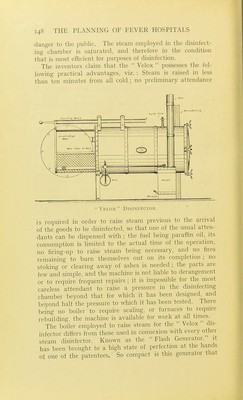
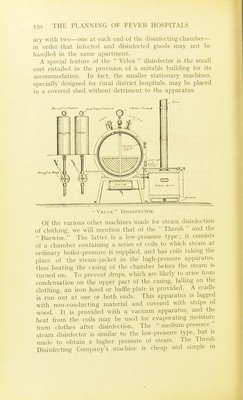
![ono capable of raising 10 horsc-povvcr of steam may, with its furnace and casing, be packed into a space measuring no more than 2 ft. square. Besides being Com])act, tlie gene- rator is capable of raising steam in an incredibly short time. It is claimed that the generator cannot explode, even at very high pressures, or when short of water, and red hot. It can, therefore, be entrusted to the care of an attendant who would be incompetent to take charge of a boiler of the ordinary description. Water is supphed to the generator from a strong steel drum, into which it is pumped by the attendant. The pump is one of a rotary type, which throws up the water required with a few strokes, and which produces an air-pressure in the drum sufficient to supply the generator for a considerable period. This method of feed renders the generator automatic in action, as if the pressure rises the water in it is forced back into the drum and the production of steam ceases. The furnace consists of a series of large Bunsen burners specially designed to consume paraffin supphed under pressure. It is regulated by a single cock, and a steady heat is main- tained. The consumption of paraffin is small, a gallon being sufficient for one disinfection from beginning to end. The perfect combustion of the paraffin with this burner leaves neither smoke nor traces of dirt. The furnace is provided with air ducts, and, in addition to raising steam, warms air to be used on the completion of the operation of disin- fecting in drying the contents of the chamber. The very highly superheated steam produced by the generator would be unsuitable for use in the disinfecting chamber. It is, therefore, passed through water contained in a drum beneath the chamber, which it enters in a state of saturation and at a reduced temperature—the condition in which it is most suitable for purposes of disinfection. The disinfecting chamber is constructed of boiler plate, and is provided with either one or two doors at the ends, as the case may be. Within, a wire basket is fitted, to contain the goods for disinfection and to facilitate charging and discharging. The chamber is fitted with safety valves, and with a coil of copper tubing around and within it for warming and drying purposes. The Velox disinfector is made in all sizes, and either as a portable or stationary machine. The principle of working is the same in all. The portable machines are fitted with one door, and the station-](https://iiif.wellcomecollection.org/image/b21360169_0175.jp2/full/800%2C/0/default.jpg)