[Report 1928] / Medical Officer of Health, Sheffield City.
- Sheffield (England). City Council
- Date:
- 1928
Licence: Attribution 4.0 International (CC BY 4.0)
Credit: [Report 1928] / Medical Officer of Health, Sheffield City. Source: Wellcome Collection.
11/112 (page 7)
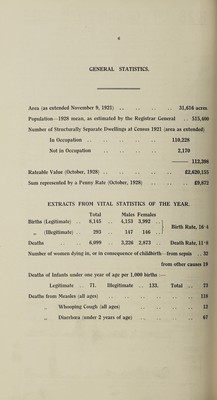
![Town Hall, Sheffield, August, 1929. To THE Chairman and Members of the Health Committee. Mr. Chairman, Ladies and Gentlemen, I have the honour to present herewith my Keport on the Health of the City during 1928. As will be seen from the figures embodied in this Report, the result of our work has been satisfactory and encouraging. The General Death Rate was 11.8 as compared with 12.3 in 1927, and an average for the previous ten years of 13.1. The summer of the year under review was on the whole sunny and fine, and the increasing habit of out-of-door living and escape into the country during week-ends is undoubtedly having an important effect, not merely on Death-rates but on the actual health and vigour of people of both sexes who are living and taking part in the life and activities of their generation. There is an irreducible limit to the reduction in the Death-rate, which we are rapidly approaching. The remarkable decline in both Birth-rate and Death-date which we have witnessed during these “ post-war ” years, means that we have now a population of considerably greater average age than we had in the past. This means that the rate of acceleration in the decline of the Death-rate must inevitably be reduced. As the population grows older there may even be some progressive rise in the Death-rate in the coming years. This is a possibility that must be faced with equanimity by those responsible for the administration of matters relating to the Public Health. Except in the case of certain scheduled “ notifiable infectious diseases,” we have no accurate knowledge of the incidence of disease generally on the population, or of what might be called the “ Morbidity rate.” I believe, however, that this has been greatly reduced, and I am sure that some considerable share in this reduction may be claimed by the Health Committee as the direct result of their labours in the gradual removing of insanitary conditions and the improvement of the envii-onment in which the majority of our fellow-citizens have to live. The outstanding feature of the year under review was the ])assing into Law of the Sheffield Corporation Consolidation Act of 1928. This Act contains a number of “ Sanitary ” Sections, and Sections dealing with the public health, more or less directly, and all of these newly acquired powers were implemented before the close of the year, with the exception of the Sections dealing with the industrial and other “ Tips,” which give us power to make By-laws regulating this form of disposal of the residuum of what we regard as modern civilization. This is a problem of great complexity, and much recent scientific research and experiment has been carried out on the subject. Until this experimental work has been thoroughly explored it has been recognisd that it would be inadvisable to commit ourselves to By-laws which might shortly become out-of-date. Our new powers to compel the conversion of trough-closets and waste water-closets to civilised separate pedestal closets, have been taken full advantage of, and I hope these remnants of a bygone conception of sanitation will soon have disappeared from our City as have the privy-middens which we inherited from Victorian times. As will be seen from the Sanitary sections of this Report, the work of replacement of the old insanitary “ ash-pit ” by Sanitary ash-bins is proceeding rapidly, and I have been able to satisfy myself that this gradual but steady progress in the cleaning up of the unclean portions of the City is having the expected effect in a general improvement, not only in the health but in the “ morale ” of the citizens. We have again a very large record of back-yards repaved, and I have repeatedly called attention to the importance of this work. The re-paving and cleansing of a back-yard or court is in my experience always an opportunity for the over¬ worked housekeeper to put her house in order and prevent the introduction of unnecessary and avoidable dirt, and I know from the lips of many over-driven women what a help to them our present policy has been.](https://iiif.wellcomecollection.org/image/b30080605_0011.jp2/full/800%2C/0/default.jpg)