A glossary of reference on subjects connected with the Far East / by Herbert A. Giles.
- Herbert Giles
- Date:
- 1886
Licence: Public Domain Mark
Credit: A glossary of reference on subjects connected with the Far East / by Herbert A. Giles. Source: Wellcome Collection.
78/302 page 66
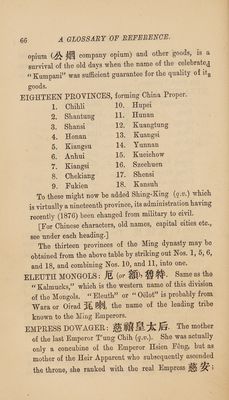
![opium company opium) and other goods, is a survival of the old days when the name of the celebrate^ ^‘Kumpani’^ was sufficient guarantee for the quality of itg goods. EIGrHTEEN PEOYINCES, forming China Proper. 1. Chihli 10. Hupei 2. Shantung 11. Hunan 3. Shansi 12. Kuangtung 4. Honan 13. Kuangsi 5. Kiangsu 14. Yunnan 6. Anhui 15. Kueichow 7. Kiangsi 16. Szechuen 8. Chekiang 17. Shensi 9. Fukien 18. Kansuh To these might now he added Shing-King {q.v.) which is virtually a nineteenth province, its administration having recently (1876) been changed from military to civil. [For Chinese characters, old names, capital cities etc,, see under each heading.] The thirteen provinces of the Ming dynasty may he obtained from the above table by striking out Nos. 1, 5, 6, and 18, and combining Nos. 10, and 11, into one. ELEUTH MONGOLS: M {or ^ Same as the Kalmucks,’’ which is the western name of this division of the Mongols. Eleuth” or ‘‘ Oelot” is probably from Wara or Oirad the name of the leading tribe known to the Ming Emperors. EMPRESS DOWAGEE: The mother of the last Emperor T’ung Chih {q.v.). She was actually only a concubine of the Emperor Hsien Feng, but as mother of the Heir Apparent who subsequently ascended the throne, she ranked with the real Empress ^ ^ 5](https://iiif.wellcomecollection.org/image/b30093120_0078.jp2/full/800%2C/0/default.jpg)
 No text description is available for this image
 No text description is available for this image
 No text description is available for this image