Observations on man, his frame, his duty, and his expectations / With a life by his son, David, and notes and additions by H.A. Pistorius, translated from the German.
- David Hartley
- Date:
- 1791
Licence: Public Domain Mark
Credit: Observations on man, his frame, his duty, and his expectations / With a life by his son, David, and notes and additions by H.A. Pistorius, translated from the German. Source: Wellcome Collection.
14/814 page 6
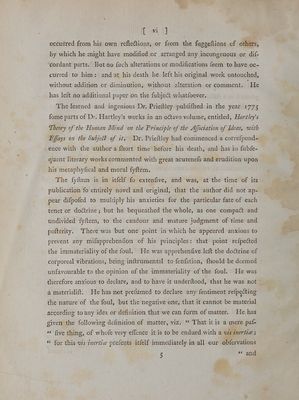
![[ wi ]] occurred from his own refledions, or from the fuggeftions of others, by which he might have modified or arranged any incongruous or dif- cordant parts. But no fuch alterations or modifications feem to have oc- curred to him: and at his death he left his original work untouched, without addition or diminution, without alteration or comment. He has left no additional paper on the fubject whatfoever. The learned and ingenious Dr. Prieftley publifhed in the year 1775 fome parts of Dr. Hartley’s works in an oftavo volume, entitled, Hartley’s Theory of the Human Mind ‘on the Principle of the Ajlociation of Ideas, with Effays on the Subjett of it. Dr. Prieftley had commenced a correfpond- ence with the author a fhort time before his death, and has in fubfe- quent literary works commented with great acutenefs and erudition upon his metaphyfical and moral fyftem. The fyftem is in itfelf fo extenfive, and was, at the time of its publication fo entirely novel and original, that the author did not ap- pear difpofed to multiply his anxieties for the particular fate of each tenet or doctrine; but he bequeathed the whole, as one compact and undivided fyftem, to the candour and mature judgment of time and pofterity. There was but one point in which he appeared anxious to prevent any mifapprehenfion of his principles: that point refpected the immateriality of thé foul. He was apprehenfive left the doctrine of corporeal vibrations, being inftrumental to fenfation, fhould be deemed _ unfavourable to the opinion of the immateriality of the foul. He was therefore anxious to declare, and to have it underftood, that he was not a materialift. He has not prefumed to declare any fentiment refpecting — the nature of the foul, but the negative one, that it cannot be material according to any idea or definition that we can form of matter. He has given the following definition of matter, viz. “ That it is a mere paf- « five thing, of whofe very eflence it is to be endued with a vis zmertie ; “ for this us inertia prefents itfelf immediately in all our obfervations](https://iiif.wellcomecollection.org/image/b33519134_0014.jp2/full/800%2C/0/default.jpg)
 No text description is available for this image
 No text description is available for this image
 No text description is available for this image