Licence: Public Domain Mark
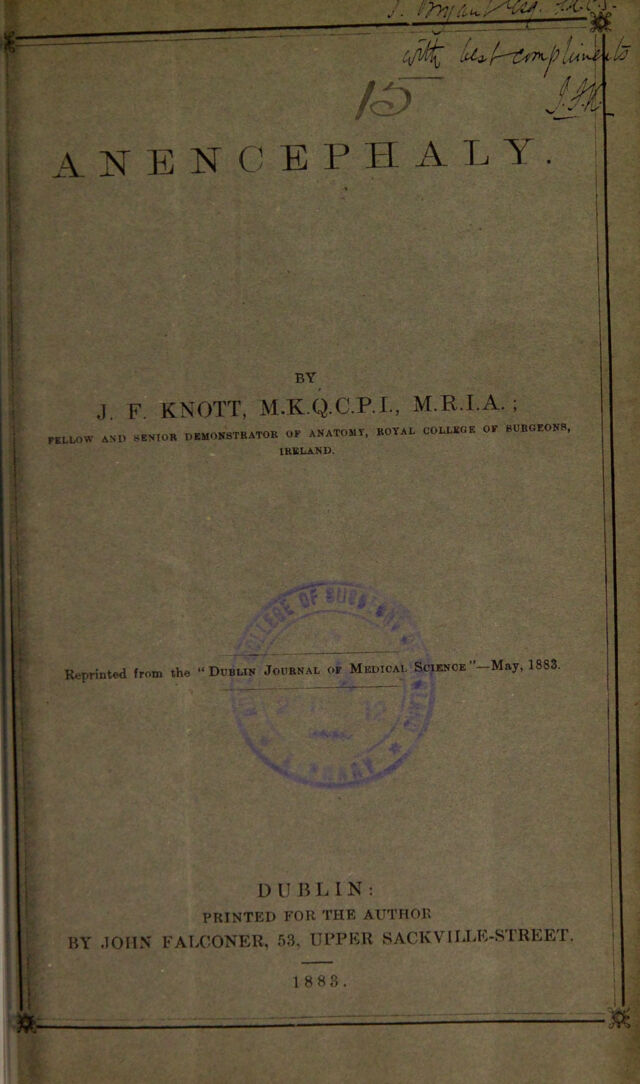
Credit: Anencephaly / by J.F. Knott. Source: Wellcome Collection.
Provider: This material has been provided by The Royal College of Surgeons of England. The original may be consulted at The Royal College of Surgeons of England.
11/14 page 7
![i rowed and placed low, and may be so much affected by pressure as to have its external surface turned downwards; the mem- 1 brana tympani may be horizontal in position, and carried towards :the middle line of the body. The complete rotation of the os ]petrosum, described by Professor Hannover in his memoir on the ; primordial cartilage, does not seem to take place in anencephalic •subjects. On the other hand, the bones which are developed in the pri- imordial cartilage undergo great changes, both in form and position. ' While the superior segment of the squama occipitis, which is ossi- Ified in membrane, is always deficient in these cases, we may find 1 traces of the inferior segment, which is ossified in the occipito- imastoid portion of the primordial cartilage; when the spina bifida iis more pronounced, there is also a fissure of tbe squama, and the I two lateral portions are pushed outwards, and placed obliquely 'with regard to the longitudinal axis of the body. The union of each with the scale to which the parietal bone is reduced continues - without change when the position of the former becomes gradually i horizontal, in such a way that the face normally turned towards the i interior comes to look directly upwards, and the posterior suface ’vertically downwards. When the spinal fissure is of still greater •extent, the two portions of the squama come at last to assume a position completely vertical, in such a way that the surface originally anterior and central is now turned outwards, and the •surface originally turned backwards is directed towards the middle line of the body. This characteristic change, by which the two | portions of the squama occipitis are so completely folded down, is ■ especially due to the contraction of those muscles of the back of the neck and occipital region which are attached to the outer surface of the affected bone, and whose action, in the absence of the vault of the cranium, there is no resistance to overcome. From this comes the singular aspect of the anencephalic foetus—it seems to have no neck, while the head rests upon the back, which indeed is partly the case, the malformed external ear also touching the shoulder. The scale of the parietal bone has also been folded down on the side of the neck, where it must be searched for. i Between the posterior extremity of the occipito-mastoid portion (i.e., the inferior part of the squama occipitis) and the free extremity of the open posterior arch of the atlas, a cartilaginous connexion sometimes forms,which must not, however, be confounded with another connexion that ‘sometimes takes place, in the normal](https://iiif.wellcomecollection.org/image/b22452163_0011.jp2/full/800%2C/0/default.jpg)