Chemistry of urine : a practical guide to the analytical examination of diabetic, albuminous and gouty urine.
- Alfred Henry Allen
- Date:
- 1895
Licence: Public Domain Mark
Credit: Chemistry of urine : a practical guide to the analytical examination of diabetic, albuminous and gouty urine. Source: Wellcome Collection.
Provider: This material has been provided by the Gerstein Science Information Centre at the University of Toronto, through the Medical Heritage Library. The original may be consulted at the Gerstein Science Information Centre, University of Toronto.
45/252 (page 27)
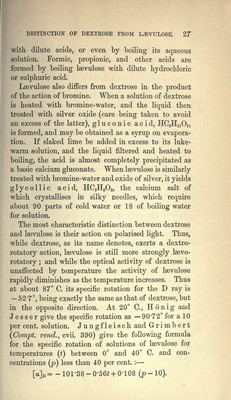
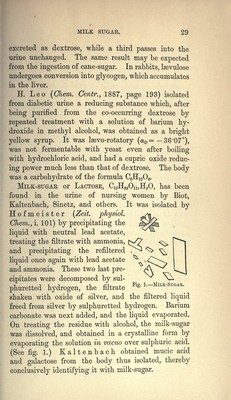
![with dilute acids, or even by boiling its aqueous solution. Formic, propionic, and other acids are formed by boiling Isevulose with dilute hydrochloric or sulphuric acid. Laevulose also differs from dextrose in the product of the action of bromine. When a solution of dextrose is heated with bromine-water, and the liquid then treated with silver oxide (care being taken to avoid an excess of the latter), gluconic acid, HCgHnO;, is formed, and may be obtained as a syrup on evapora- tion. If slaked lime be added in excess to its luke- warm solution, and the liquid filtered and heated to boiling, the acid is almost completely precipitated as a basic calcium gluconate. When Isevulose is similarly treated with bromine-water and oxide of silver, it yields glycollic acid, HC2H3O3, the calcium salt of which crystallises in silky needles, which require about 90 parts of cold water or 18 of boiling water for solution. The most characteristic distinction between dextrose and laevulose is their action on polarised light. Thus, while dextrose, as its name denotes, exerts a dextro- rotatory action, laevulose is still more strongly Isevo- rotatory ; and while the optical activity of dextrose is unaffected by temperature the activity of laevulose rapidly diminishes as the temperature increases. Thus at about 87° C. its specific rotation for the D ray is — 527°, being exactly the same as that of dextrose, but in the opposite direction. At 20° C, Ho nig and J e s s e r give the specific rotation as — 90*72° for a 10 per cent, solution. Jungfleiach and Grimbert {Compt. rend,, cvii. 390) give the following formula for the specific rotation of solutions of laevulose for temperatures {t) between 0° and 40° C. and con- centrations (p) less than 40 per cent. :— [a]D= -101-38-0-56^4-0-108 (i?-10).](https://iiif.wellcomecollection.org/image/b2097484x_0045.jp2/full/800%2C/0/default.jpg)