A dictionary of domestic medicine and household surgery / by Spencer Thomas.
- Date:
- 1883
Licence: Public Domain Mark
Credit: A dictionary of domestic medicine and household surgery / by Spencer Thomas. Source: Wellcome Collection.
Provider: This material has been provided by Royal College of Physicians, London. The original may be consulted at Royal College of Physicians, London.
41/764 page 21
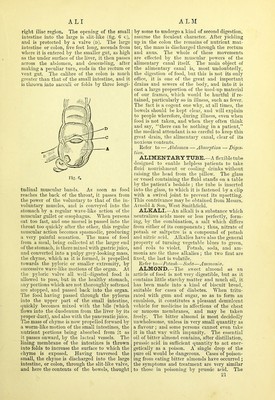
![right iliac region. The opening of the small intestine into the large is slit-like (fig. 6 c), and is protected by a valve (d). The large intestine or colon, live feet long, ascends from where it is entered by the smaller gut, as high as the under surface of the liver, it then passes across the abdomen, and descending, after making a peculiar turn, ends in the rectum or vent gut. The calibre of the colon is much greater tlian that of the small intestine, and it is thrown into sacculi or folds by three longi- tudinal muscular bands. As .soon as food reaches the back of the throat, it passes from the power of the voluntary to that of the in- voluntary muscles, and is conveyed into the stomach by a regular wave-like action of the muscular gullet or oesophagus. 'When persons eat too fast, and one morsel is passed into the throat too quickly after the other, this regular muscular action becomes spasmodic, producing a very painful sensation. The mass of food irom a meal, being collected at the larger end of the stomach, is there mixed with gastric juice, and converted into a pulpy grey-looking mass, the chyme, which as it is formed, is propelled towards the pyloric or smaller extremity, by .successive wave-like motions of the organ. At tlie pyloric valve all well - digested food is allowed to pass, but in the healthy stomach, ;uiy portions which are not thoroughly softened are stopped, and passed back into the organ. The food having passed through the pylorus into the upper part of the small intestine, quickly becomes mixed with the bile (which Hows into the duodenum from the liver by its proper duct), and also with the pancreatic juice. The mass of chyme is now propelled forward by a worm-like motion of the small intestines, the nutrient portions being absorbed from it as it passes onward, by the lacteal vessels. The lining membrane of the intestines is thrown into folds to increase the surface to which the chyme is exposed. Having traversed the small, the chyme is discharged into the large intestine, or colon, through the slit-like valve, and here the contents of the bowels, thought by some to undergo a kind of second digestion, assume the feculent character. After yielding up in the colon the remains of nutrient mat- ter, the mass is discharged through the rectum and anus. The whole of these movements are eifected by the muscular powers of the alimentary canal itself. The main object of the alimentary canal is, most undoubtedly, the digestion of food, but this is not its only office, it is one of the great and important drains and sewers of the body, and into it is cast a large ])roportion of the used-up material of our frames, which would be hurtful if re- tained, particularly so in illness, such as fever. The fact is a cogent one why, at all times, the bowels should be kept clear, and will explain to people wherefore, during illness, even when food is not taken, and when they often think and say, “there can be nothing in a patient,” the medical attendant is so careful to kceii this great drain, the alimentary canal, clear of its noxious contents. Kefer to — Abdomen — Absorption — Diges- tion. ALIMENTARY TUBE.—A flexible tube designed to enable helpless patients to take iiuid nourishment or cooling drinks without raising the head from the i)illow. The glass or vessel containing the fluid stands on a table Ijy the patient’s bedside ; the tube is inserted into the glass, to wdiich it is fastened by a clip with a swivel joint to prevent its upsetting. This contrivance may be obtained from Messrs. Arnold & Son, West Smithiield. ALKALI.—An alkali is a substance which neutralizes acids more or less perfectly, form- ing, by the combination, a salt which differs from either of its components ; thus, nitrate of potash or saUqjetre is a compound of potash and nitric acid. Alkalies have also the general property of turning vegetable blues to green, and reds to violet. Potash, soda, and am- monia are the three alkalies ; the two first are fixed, the last is volatile. Refer to—Potash—Soda—Ammonia. ALMOND.—The sweet almond as an article of food is not veiqr digestible, but as it contains little starchy matter and much oil, it has been made into a kind of biscuit bread, suitable for cases of diabetes. When tritu- rated with gum and sugar, so as to form an emulsion, it constitutes a pleasant demulcent vehicle for medicine in aflections of the chest or mucous membranes, and may be taken freelj'. The bitter almond is most decidedly unwholesome, unless in very small quantity as a flavour ; and some persons cannot even take it in that way with impunity. The essential oil of bitter almond contains, after distillation, prussic acid in sufficient quanti ty to act ener- getically as a poison. A single drop of the pure oil would be dangerous. Cases of poison- ing from eating bitter almonds have occurred ; the symptoms and treatment are very similar to those in poisoning by prussic acid. The](https://iiif.wellcomecollection.org/image/b28040326_0041.jp2/full/800%2C/0/default.jpg)

 No text description is available for this image
 No text description is available for this image
 No text description is available for this image