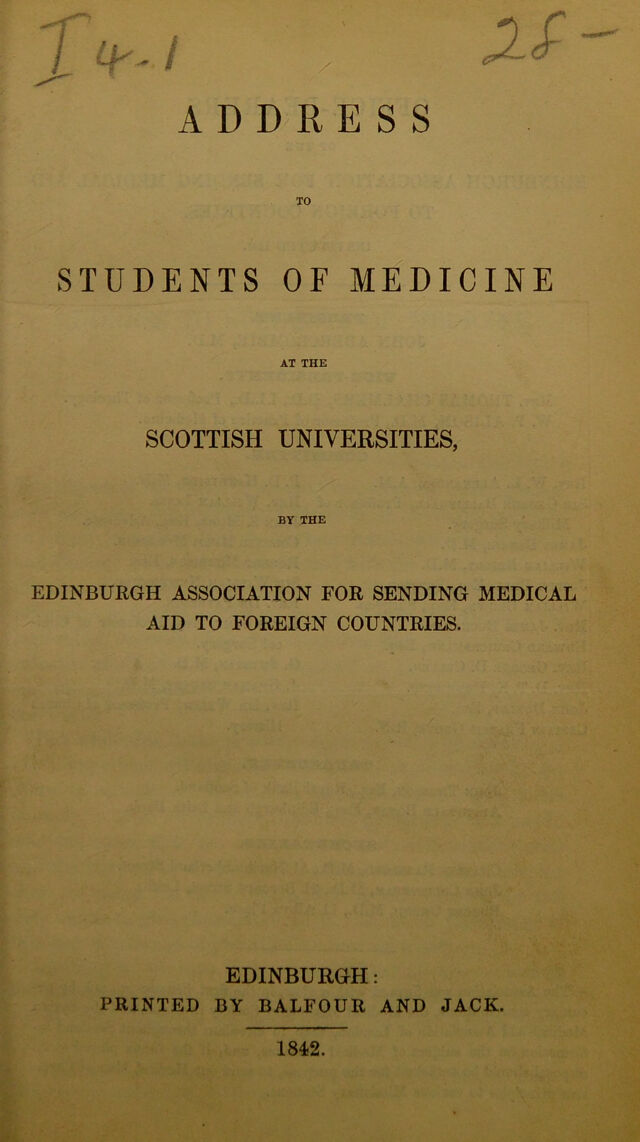
Address to students of medicine at the Scottish Universities / by the Edinburgh Association for Sending Medical Aid to Foreign Countries.
- Date:
- 1842
Licence: Public Domain Mark
Credit: Address to students of medicine at the Scottish Universities / by the Edinburgh Association for Sending Medical Aid to Foreign Countries. Source: Wellcome Collection.
Provider: This material has been provided by the Royal College of Physicians of Edinburgh. The original may be consulted at the Royal College of Physicians of Edinburgh.
26/58 page 12
![] o if he had that degree oi intellect to enable him to know and distin- guish right from wrong ; if he knew what would be the effect of the crime, and, consequently, committed it, and if with that conscious- ness he wilfully committed it.” (The Times, 6th March 1843.) Lord-Chief Justice Tindal, after stopping the trial, as he and the other judges considered the medical evidence amply sufficient to prove the insanity of the prisoner, in the few words which he addres- sed to the jury stated—“The point 1 shall have to submit to you is, whether, on the whole of the evidence you have heard, you are sa- tisfied, that, at the time the act was committed, for the commission of which the prisoner now stands charged, he had that competent use of his understanding, as that he knew that he was doing, by the very act itself, a wicked and wrong thing? If he was not sensible at the time he committed that act, that it was a violation of the laws of God or of man, undoubtedly he was not responsible fo,r that act, or liable to any punishment whatever flowing from that act.” • • • “ If, on balancing the evidence in your minds, you think the prisoner capable of distinguishing between right and wrong, then he was a responsible agent, and liable to all the penalties the law imposes. If not so, and, if in your judgment the subject should appear in very great difficulty, then yon would probably not take upon yourselves to find the prisoner guilty. If that is your opinion then you will ac- quit the prisoner.” It will be seen from these quotations that the law of England re- lative to the responsibility of the insane has, in all ages, been simi- larly interpreted ; and it has been solely from the difficulty of ap- plying the law to particular cases, but, more especially, from judge and jury leaning too much to the vague and unsatisfactory medical opinions that many criminals, with a plausible show of humanity, have, of late years, been acquitted on the plea of insanity, who were most undoubtedly responsible agents, and amenable to the laws of their country. The deeply-lamented murder of Mr Drummond by the hand of a supposed maniac, caused the subject of the “ plea of insanity in cri- minal cases” to be commented on in the House of Lords; and the able speakers on that occasion, not only entirely agreed with Lord Hale, Lord-Chief-Justice Mansfield, and others, as to the interpre- tation they had put on the law relating to insanity, but stated it as their conviction that that law could not with propriety be altered. The eminence of the Noble Lords who took part in that debate ren- ders all apology unnecessary for quoting so much of their speeches as are applicable to the present subject. The Lord Chancellor, after stating that the law relative to the plea of insanity in criminal cases was clear, was distinct, was defined, quoted it as laid down by Mr Justice Le Blanc at the trial of Bowler, (see above) and continued : “ That, my Lords, is the law of tbe land so far as it relates to men labouring under some delusion and, while it is upon them, acting under its influence,— if it be so powerful as to render them incapable of distinguishing right from wrong*](https://iiif.wellcomecollection.org/image/b28040880_0026.jp2/full/800%2C/0/default.jpg)