Outlines of human physiology / by F. Schenck and August Gürber, authorized translation from the second German edition by Wm. D. Zoethout with a preface of Jacques Loeb.
- Friedrich Wilhelm Julius Schenck
- Date:
- 1900
Licence: Public Domain Mark
Credit: Outlines of human physiology / by F. Schenck and August Gürber, authorized translation from the second German edition by Wm. D. Zoethout with a preface of Jacques Loeb. Source: Wellcome Collection.
Provider: This material has been provided by the Augustus C. Long Health Sciences Library at Columbia University and Columbia University Libraries/Information Services, through the Medical Heritage Library. The original may be consulted at the the Augustus C. Long Health Sciences Library at Columbia University and Columbia University.
301/358 page 289
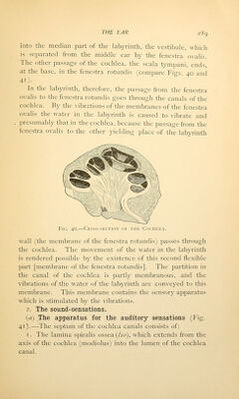
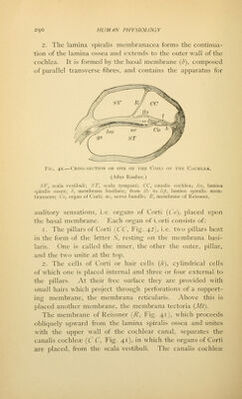
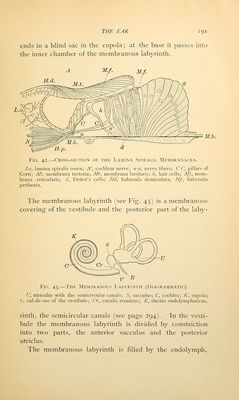
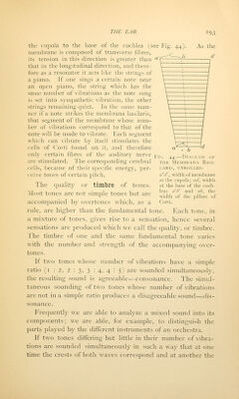
![into the median part of the labyrinth, the vestibule, which is separated from the middle ear by the fenestra ovalis. The other passage of the cochlea, the scala tympani, ends, at the base, in the fenestra rotundis (compare Figs 40 and 40- In the labyrinth, therefore, the passage from the fenestra ovalis to the fenestra rotundis goes through the canals of the cochlea. By the vibrations of the membranes of the fenestra ovalis the water in the labyrinth is caused to vibrate and presumably that in the cochlea, because the passage from the fenestra ovalis to the other yielding place of the labyrinth Fig. 40.—Cross-section of the Cochlea. wall (the membrane of the fenestra rotundis) passes through the cochlea. The movement of the water in the labyrinth is rendered possible by the existence of this second flexible part [membrane of the fenestra rotundis]. The partition in the canal of the cochlea is partly membranous, and the vibrations of the water of the labyrinth are conveyed to this membrane. This membrane contains the sensory apparatus which is stimulated by the vibrations. 2. The sound-sensations. (a) The apparatus for the auditory sensations (Fig. 41).—The septum of the cochlea canals consists of: 1. The lamina spiralis ossea (/so), which extends from the axis of the cochlea (modiolus) into the lumen of the cochlea canal.](https://iiif.wellcomecollection.org/image/b21208256_0301.jp2/full/800%2C/0/default.jpg)