Outlines of human physiology / by F. Schenck and August Gürber, authorized translation from the second German edition by Wm. D. Zoethout with a preface of Jacques Loeb.
- Friedrich Wilhelm Julius Schenck
- Date:
- 1900
Licence: Public Domain Mark
Credit: Outlines of human physiology / by F. Schenck and August Gürber, authorized translation from the second German edition by Wm. D. Zoethout with a preface of Jacques Loeb. Source: Wellcome Collection.
Provider: This material has been provided by the Augustus C. Long Health Sciences Library at Columbia University and Columbia University Libraries/Information Services, through the Medical Heritage Library. The original may be consulted at the the Augustus C. Long Health Sciences Library at Columbia University and Columbia University.
39/358 page 27
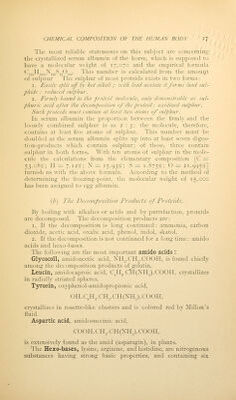
![The most reliable statements on this subject are concerning the crystallized serum albumin of the horse, which is supposed to have a molecular weight of 17,070 and the empirical formula C,..H,„.N,„-S,„0.„.. This number is calculated from the amount OD 1210 19a 10 2.5.0 * of sulphur The sulphur of most proteids exists in two forms: 1. Easily split off by hot alkali; with lead acetate it forms lead sul- phide : reduced sulphur. 2. Firmly bound to the proieid molecule, only demonstrable as sul- phuric acid after the decomposition of the proteid: oxidized sulphur. Such proteids must contain at least two atoms of sulphur. In serum albumin the proportion between the firmly and the loosely combined sulphur is as 2:3: the molecule, therefore, contains at least five atoms of sulphur. This number must be •doubled as the serum albumin splits up into at least seven diges- tion-products which contain sulphur; of these, three contain .sulphur in both forms. With ten atoms of sulphur in the mole- cule the calculations from the elementary composition [C = 53.08^; H = 7.12^; X = 15.93^; S = 1.875^; O = 21.995$] furnish us with the above formula. According to the method of •determining the freezing-point, the molecular weight of 15,00.0 (h) The Decomposition Products of Proteids. By boiling with alkalies or acids and by putrefaction, proteids .are decomposed. The decomposition products are: 1. If the decomposition is long continued: ammonia, carbon dioxide, acetic acid, oxalic acid, phenol, indol, skatol. 2. If the decomposition is not continued for a long time: amido acids and hexo-bases. The following are the most important amido acids : Glycocoll, amidoacetic acid, XH„. CH2.COOH, is found chiefly among the decomposition products of gelatin. Leucin, amidocaproic acid, C1H9.C*H(XH:,).COOH, crystallizes in radially striated spheres. Tyrosin, oxyphenol-amidopropionic acid, OH.C6H4.CH2.CH(NH2).COOH, crvstallizes in rosette-like clusters and is colored red by million's fluid. Aspartic acid, amidosuccinic acid, COOH. CH2. CH(XH.,). COOH, is extensively found as the amid (asparagin), in plants. The Hexo-bases, lysine, arginine, and histidine, are nitrogenous substances having strong basic properties, and containing six](https://iiif.wellcomecollection.org/image/b21208256_0039.jp2/full/800%2C/0/default.jpg)