Outlines of human physiology / by F. Schenck and August Gürber, authorized translation from the second German edition by Wm. D. Zoethout with a preface of Jacques Loeb.
- Friedrich Wilhelm Julius Schenck
- Date:
- 1900
Licence: Public Domain Mark
Credit: Outlines of human physiology / by F. Schenck and August Gürber, authorized translation from the second German edition by Wm. D. Zoethout with a preface of Jacques Loeb. Source: Wellcome Collection.
Provider: This material has been provided by the Augustus C. Long Health Sciences Library at Columbia University and Columbia University Libraries/Information Services, through the Medical Heritage Library. The original may be consulted at the the Augustus C. Long Health Sciences Library at Columbia University and Columbia University.
58/358 page 46
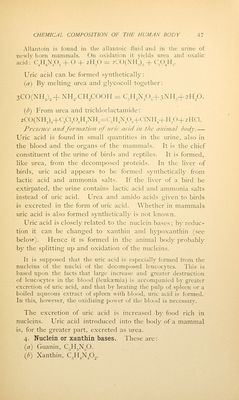
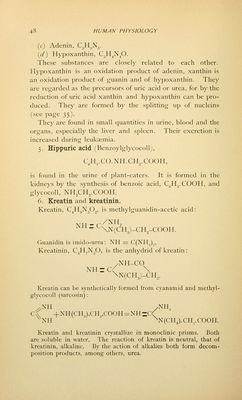
![seems to be to change the injurious ammonia formed by proteid metabolism into a harmless compound. It is a question, however, whether all the urea formed in the body is derived from ammonia or ammonia derivatives. it is probable that some of the urea can also be directly split off from the proteid. 3. Uric acid, C.r^X/),, has the structural formula: NH-CO / ' \ pCO. [Diureid of trioxyacrylic acid.] \XH-C-XH/ Pure uric acid crystallizes in colorless, rhombic prisms, but directly from the urine it yields bundles of colored dumb- bell and whetstone crystals. Uric acid is but slightly solu- ble in cold water (0.05 g in one liter); it is a little more soluble in hot water (0.5 g in one liter) or in the presence of urea; it is insoluble in alcohol and ether. As a dibasic acid it forms neutral and acid salts. The neutral alkali salts are quite soluble in water; the acid salts are also more soluble than the free acid. But these are precipitated even by the cooling of the urine and, as they take with them the pigments of the urine, they form reddish precipitates (sedi- mentum lateritium). The salts of uric acid with the alkali-earths, most of the metals, and also ammonia are not very soluble in water. Because of the comparative insolubility of uric acid, it is easily deposited in the kidneys, ureters and the tissues of the body (gravel, gout). If uric acid to which nitric acid has been added is evap- orated to dryness and to the residue ammonia is added, a reddish-violet color results which gives place to a bluish violet on addition of sodium hydrate {inurexide test for uric acid). By careful oxidation of uric acid, allantoin and carbon dioxide are formed: C.H4N40, -f O + H20 = C4H6N4Oa allantoin; -f C02.](https://iiif.wellcomecollection.org/image/b21208256_0058.jp2/full/800%2C/0/default.jpg)