[Report of the Medical Officer of Health for London, City of ].
- City of London (London, England). Corporation of London.
- Date:
- 1970
Licence: Attribution-NonCommercial 4.0 International (CC BY-NC 4.0)
Credit: [Report of the Medical Officer of Health for London, City of ]. Source: Wellcome Collection.
7/54 page 5
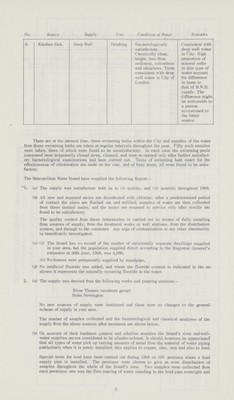
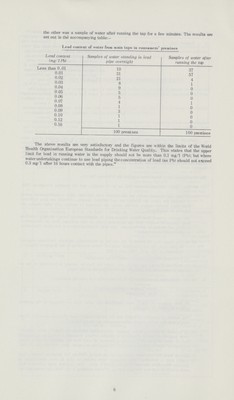
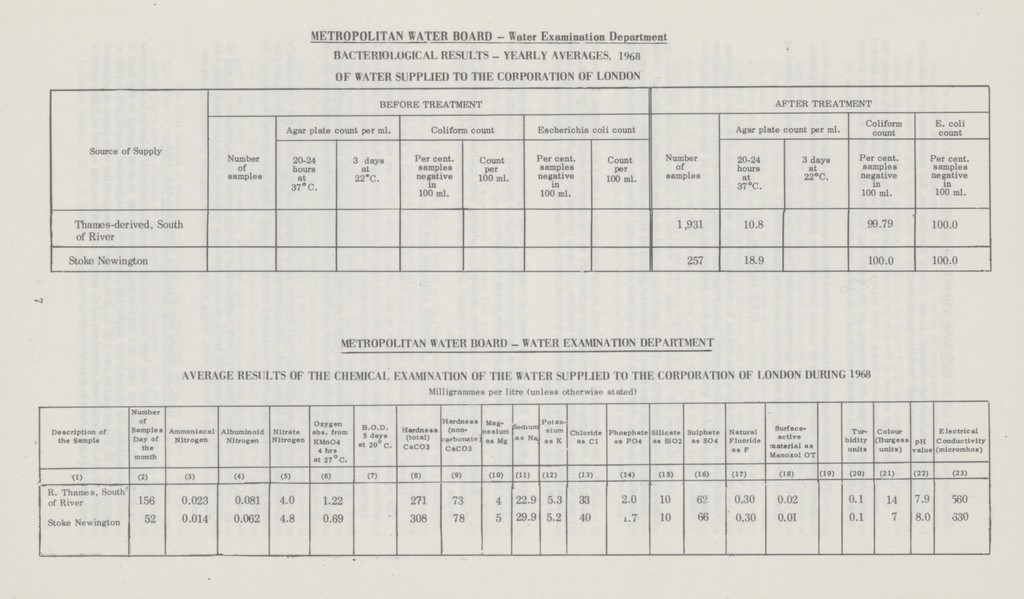
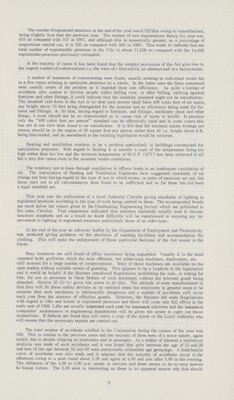
![5 [???]No. Source Supply Use Condition of Water Remarks 6. Kitchen Sink. Deep Well Drinking Bacteriologically satisfactory. Chemically clear, bright, free from sediment, colourless and odourless. Taste consistent with deep well water in City of London. Consistent with deep well water in City. High proportion of mineral salts in this type of water account for difference in taste to that of M.W.B. supply. The difference might be noticeable to a person accustomed to the latter source. There are at the present time, three swimming baths within the City and samples of the water from these swimming baths are taken at regular intervals throughout the year. Fifty such samples were taken, three of which were found to be unsatisfactory. In each case the swimming pools concerned were temporarily closed down, cleaned, and were re-opened only after further satisfact ory bacteriological examinations had been carried out. Tests of swimming bath water for the effectiveness of chlorination are made on the site, and of forty tests, all were found to be satis factory. The Metropolitan Water Board have supplied the following Report: 1. (a) The supply was satisfactory both as to (i) quality, and (ii) quantity throughout 1968. (b) All new and repaired mains are disinfected with chlorine; after a predetermined period of contact the pipes are flushed out and refilled; samples of water are then collected from these treated mains; and the mains are returned to service only after results are found to be satisfactory. The quality control from these laboratories is carried out by means of daily sampling from sources of supply, from the treatment works or well stations, from the distribution system, and through to the consumer. Any sign of contamination or any other abnormality is immediately investigated. (c) (i) The Board has no record of the number of structurally separate dwellings supplied in your area, but the population supplied direct according to the Registrar General's estimates at 30th June, 1968, was 4,090. (ii) No houses were permanently supplied by standpipe. (d) No artificial fluoride was added, and where the fluoride content is indicated in the an alyses it represents the naturally occurring fluoride in the water. 2. (a) The supply was derived from the following works and pumping stations:— River Thames (southern group) Stoke Newington No new sources of supply were instituted and there were no changes to the general scheme of supply in your area. The number of samples collected and the bacteriological and chemical analyses of the supply from the above sources after treatment are shown below. (b) On account of their hardness content and alkaline reaction the Board's river andwell water supplies are not considered to be plumbo-solvent. It should, however, be appreciated that all types of water pick up varying amounts of metal from the material of water piping particularly when it is newly installed; this applies to copper, zinc, iron and also to lead. Special tests for lead have been carried out during 1968 on 100 pemises where a lead supply pipe is installed. The premises were chosen to give an even distribution of samples throughout the whole of the Board's area. Two samples were collected from each premises; one was the first running of water standing in the lead pipe overnight and](https://iiif.wellcomecollection.org/image/b18253854_0007.jp2/full/800%2C/0/default.jpg)
 No text description is available for this image
 No text description is available for this image
 No text description is available for this image