Goldsmith's Natural history : with notes from all the popular treatises that have been issued since the time of Goldsmith ... / [edited] by Henry Innes, with a life of Oliver Goldsmith by George Moir Bussey.
- Oliver Goldsmith
- Date:
- [18??]
Licence: Public Domain Mark
Credit: Goldsmith's Natural history : with notes from all the popular treatises that have been issued since the time of Goldsmith ... / [edited] by Henry Innes, with a life of Oliver Goldsmith by George Moir Bussey. Source: Wellcome Collection.
29/860 page 9
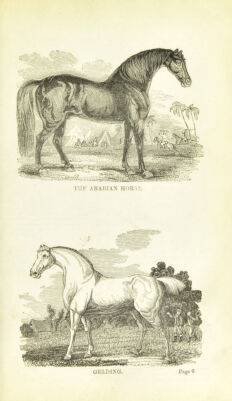
![^ I rtiire diminutive ami ill-shaped We have the testimony of the ancients ihal there were wild horses once in Europe; at present, however, they are totally brought under subjection ; and even those which are found in America are of a Spanish breed, which being sent thither upon its first discovery, have since become wild, and have spread over all the south of that vast continent, almost to tlie Straits of Magellan/ These, in general, are a small breed, of about fourteen hands high. They have thick, jaws and clumsy joints; their ears and neck also are long ; they are easily tamed ; for the horse by nature is a gentle, complying creature, and resists rather from fear than obstinacy. They are caught by a kind of noose, and then held fast by the legs, and tied to a tree, where they are left for two days, without food or drink.f By that time, they begin to no bridles; but theii armour and their trap- pings must have compensateil for these defi- ciences by its extraordinary splendour.* * Wii.n Houses ov South America.— Tbe wild horses which exist in the Extensive plains of South America, are descendants ot those introduced Ijy the Spaniards. In the province of Cumana, there are great numbers of wild horses in the forests. They go in com- jwnies, generally to the, extent of five or six hundred. Tliey occupy the great savannas, where it is difficult to disturb or tiy to catch them. In the dry season, they are sometimes obliged to go two or three leagues, and even more, in search of water. They set out in regular ranks—four a-breast. Five or six scouts precede tbe troop by about fitly paces. If they perceive an enemy, they neigh, and the troop stops ; if avoided, they continue their march; but if any one dare to march across their squadron, they turn on him, and cnish him under their feet. No foe is capa- ble of withstanding their attack. They have a regular chief, who marches between the scouts and the squadron—a kind of adjutant, whose duty consists in hindering any indi- vidual from quitting the ranks. If any one attempts to straggle, either from hunger or fatigue, he is bitten till he resumes his place. When wild horses are feeding, should any stragglers he threatened with an attack, by a jiarticular signal, which they all understand, they close kito a dense mass, and trample the assailant to death. When an attack is re- solved upon, their leader shows the example; and if he consider a retreat necessary, he gives the signal, and it is instantly obeyed. Wii.u Horses of North America.— Ilenls of wild horses, the offspring of those which have escaped from the Spanish posses- sions in Mexico, are not uncommon on the extensive prairies that lie to the west of the Mississippi. They were once numerous on the Kootannie Lands, near the northern sources of the Columbia. They are not known to exist in a wild state to the north- ward of the 52nd or 53rd parallel of latitude. The young stallions live in separate herds, being driven away by the old ones, and are easily ensnared by using domestic mares as • From Shrei'8 of Antiquity,” an unpuhliKheil •Turk of Tennant, tin* iiutlior of Asstib FaIK. ’ a decoy. The natives are acquainted with the Spanish-American method of taking them with the lasso. Major Long mentions that “ horses are an object e ' a particular hunt to the Osages. For the i..:»i\)se of obtaining these animals, wliioh :u thek wild state pre- serve all their flecrness, they ge I’’ a large party to the country of the Red Caaudian River, where they are to be found in coi».ji- derable numbers. When they discover ^ gang of horses, they distribute themselves into three parties, two of which take their stations at different and proper distances on their route, which, by previous experience, they know the horses will most probably take when endeavouring to escape. This arrangement being completed, the first parly commences the pursuit in the direction of their colleagues, at whose position lliev at length arrive. The second party then con tinues the chase with fresh horses, and pur • sues the fugitives to the third party, which generally succeeds in so far running them down, as to noose and capture a considerable number of them.” The domestic horse is an object of great value to the Nomadic tribes of Indians that frequent the extensive plai.is of the Missouri, &c.; for they are not only useful in transporting their tents and families from place to place, but one of the highest objects of the ambition of a young Indian is to ])ossess a good horse, for the chase of the bufiirlo—an exercise of which they are pas- sionately fond. To steal the horse of an ad- verse tribe is considered to be nearly as heroic an exploit as killing an enemy on the field of battle; and the distance to which they occasionally travel, and the privations they undergo on their horse-stealing excur- sions, are almost incredible. An Indian who owns a horse scarcely ever ventures to sleep after night-fall, but sits at the door of his tent, with the halter in one hand, and his gun in the other, the horse’s fore legs being at the saint time tied together with thongs of leather. Notwithstanding all this care, however, it happens very often that the hunter, suffering himself to be overpowered by sleep for a few moments, awakes from the noise made by the thief galloping off with the animal.—Richard's American Ztolugy. t JCapture of the Wii.D Hoksk.—Cup](https://iiif.wellcomecollection.org/image/b29010585_0029.jp2/full/800%2C/0/default.jpg)