Goldsmith's Natural history : with notes from all the popular treatises that have been issued since the time of Goldsmith ... / [edited] by Henry Innes, with a life of Oliver Goldsmith by George Moir Bussey.
- Oliver Goldsmith
- Date:
- [18??]
Licence: Public Domain Mark
Credit: Goldsmith's Natural history : with notes from all the popular treatises that have been issued since the time of Goldsmith ... / [edited] by Henry Innes, with a life of Oliver Goldsmith by George Moir Bussey. Source: Wellcome Collection.
753/860 page 377
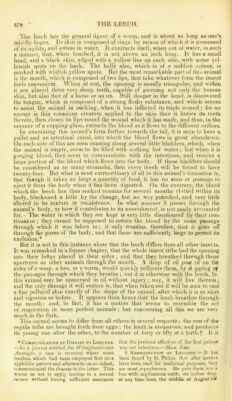
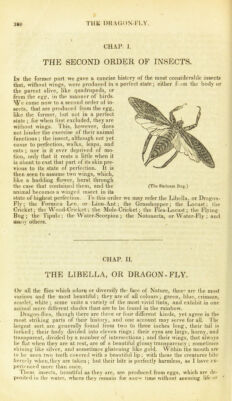
![»77 m the n'l'Ist of a circle of burning charcoal, and thus an egress prevented on eveo side ; the scorpion, as I am assured, runs for about a minute round the escapmp:, but finding that impossible, it stings itself on the ” f • Pf ® j’ ^9'® niafner the undaunted suicide instantly expires.* ♦k • r worms and wisects; and upon a proper supply these, their lives might be Ipgthened to their natnrd extent. How long that may be we are not told; but if we may argue from analogy, it cannot be less than seven or eight years; and perhaps, in the larger kind, double that dura- an;m=,]fn ’7 t^e form of the lobster, so they resemble that u ‘•leir skin, since it is softer by far than the covering of the lobster, and set with hairs, which grow from it in great 7 ^ JOi>ngs- The young lie in the womb of the nnd ^ covered up in its own membrane, to the number of forty or fifty CHAP. IX. THE LEECH. The last of this wingless tribe that 1 shall mention is the leech, which, like all the former, undergoes no va- rieties of transformation; but when once excluded from the bo(^ of the parent, preserves its first figure to the end.f The leech, from its uses in medicine, is one of those in- sects that man has taken care fc ^provide ; but, of a great va- (The Leech.) . !• j I • , . i->iwviuc, uiu, oi a great va- riety, one kind only is considered as serviceable. The horse-leech which is the largest of all, and grows to fdiir inches in length, with a glossy black surface, is oi no use, as It will not stick to the skin ; the snail-leech is but an inch in length, and though it will stick, is not large enough to extract a sufficient quantity of blood from the patient; the broad-tailed leech, which grows to an inch and a half in length, with the back raised into a sort of a ridge, will stick but on very few occasions : It is the large brpwn leech, with a whitish belly, that is made use oi in medicine, and whose history best merits our curiosity. • The poet has converted the fact into a striking illustration when treating of the 6ercer passions.—£o. The roinri that bruodi o'er guilty woes. Is like the scorpion girt by fire In circle narrowing as it glows. Till, inly searched by thuusaud throes. And maddeiiiug in her ire. One sad and sole relief she kuows. The sting she nourished for lier foes, Wliose venom never yet waa vain, ^ Gives but oue pang, and cures all pain. And darts into lier desperate brain; So do the dark in soul expire. Or live like scorpion girt by Are.—Btron. ^ Thb Fluho Leech—Is conunon in the jungles in the interior of Ceylon; and the uative troops, on their march to Canely, suf- fered very severely from their bite, occasion- ally even to the loss of life or limb : their legs were covered with them, and streamed with blood. I saw one of these animals in a horse’s leg. It is much smaller than the common leech, the largest, when at rest, be- ing not more than hall an inch long, and may be extended till it becomes a fine string-—the smaller ones are very minute. They possess the power of springing, by means of a fila- ment. too considerable distance.—Hebar’i NaRRATI>'X. 92](https://iiif.wellcomecollection.org/image/b29010585_0753.jp2/full/800%2C/0/default.jpg)