Goldsmith's Natural history : with notes from all the popular treatises that have been issued since the time of Goldsmith ... / [edited] by Henry Innes, with a life of Oliver Goldsmith by George Moir Bussey.
- Oliver Goldsmith
- Date:
- [18??]
Licence: Public Domain Mark
Credit: Goldsmith's Natural history : with notes from all the popular treatises that have been issued since the time of Goldsmith ... / [edited] by Henry Innes, with a life of Oliver Goldsmith by George Moir Bussey. Source: Wellcome Collection.
777/860 page 401
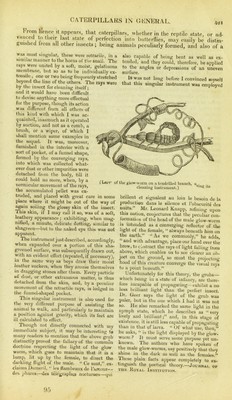
![CATUllPILLAKS IN GliNERAL. 4u, From hence it appears, that caterpillars, whether in the reptile state, or ad- vanced to their last state ol perfection into biifterllies, may easily be distbi- giuslied Irom all other insects; being animals peculiarly formed, and also of a also capable of being bent as well as ex- tended, and they could, therefore, be applied to the angles or depressions of an uneven surface. 1» WM not long before I convinced myseli that this singular instrument was employed was most singular, these were retracile, in a similar manner to the horns of tlie snail. The rays were united by a soft, moist, gelatinous membrane, but so as to be individually ex- tensile , one or two being frequently stretched beyond the line of the others. The rays were by the insect for cleaning itself; and it would have been difRcidt to devise anything more effectual for the purpose, though its action was different from all others of this kind with which I was ac- quainted, inasmuch as it operated by suction, and not as a comb, a brush, or a wiper, of which I shall mention some examples in the sequel. It was, moreover, furnished in the interior with a sort of pocket, of a funnel shape, formed by the converging rays, into which was collected what- ever dust or other impurities were detacheil from the body, till it could hold no mure, when, by a vermicular movement of the rays, the accumulated pellet was ex- truded, and placed with great care in some place where it might be out of the way of again soiling the glossy skin of the insect. This skin, if I may call it so, was of a soft, leathery appearance ; exhibiting, when mag- nified, a minute, delicate dotting, similar to shagreen—but to the naked eye this was not apparent. The instrument just described, accordingly, when expanded over a portion of this sha- greened surface, was subsequently drawn out, with an evident effort (repeated, if necessary), in the same way as Iwys draw their moist leather suckers, when they amuse themselves in dragging stones after them. Every jiarticle •I dust, or other extraneous matter, is thus detached from the skin, and, by a jHxuliiir movement of the retractile rays, is lodged in the funnel-shaped pocket. This singular instmment is also used for tlie very different purpose of assisting the animal to walk, and particularly to maintain a position against gravity, which its feet are ill calculated to effect. Though not directly connected with mv immediate subject, it may be interesting ti many readers to mention that the above grub distinctly proved the fallacy of the common doctrine respecting the light of the glow worm, which goes to maintain that it is a lamp, lit up by the female, to direct the darkling flight of the male. “ Ce sont,” ex- claims Dumeril, “ les flambeaux de I’amour-- des jiharesr—des telegraphe# nocturnes—qui (Larv of the ^U>w.»orm on a teiidriUed branch, u . cleuuiiig instrument.) brillent et signalent au loin le besoiti de la production dans le silence et I’obscurite des nuits.” Mr. Leonard Knapp, refining upon this notion, conjectures that the peculiar con- formation of the head of the male glow-worm is intended a.s a converging reflector of the light of the female, “always beneath him on the earth.” “As we commonly,” he adds, “ and with advantage, place our hand over the brow, to c'ostruct the rays of light fulling Irom above, which enables us to sue clearer an ob- ject on the ground, so must the projecting hood of this creature converge the visual rays to a point beneath.” Unfortunately for this theory, the grubs which being in a state of infancy, are there- fore incapable of propagating—exhibit a no less brilliant light than the iierfect insect. Dr. Geer says the light of the grub was paler, but in the one which 1 had it was not so. He also remarked the same light in the nymph state, which he describes as “ very lively and brilliant;” and, in this stage of existence, it is still less capable of propagating than in that of larva. “ Of what use, then ” he asks, “ is the light displayed by the glow- worm ? It must serve some iiurpuse yet un- known. The authors who have sjxiken of the male glow-worms, say positively that they shine in the dark as well as the females.” These plain facts appear completely to ex- tinguish the ]H>etical theory.—Jouunai, ov tuk Koyai, Institution.](https://iiif.wellcomecollection.org/image/b29010585_0777.jp2/full/800%2C/0/default.jpg)